
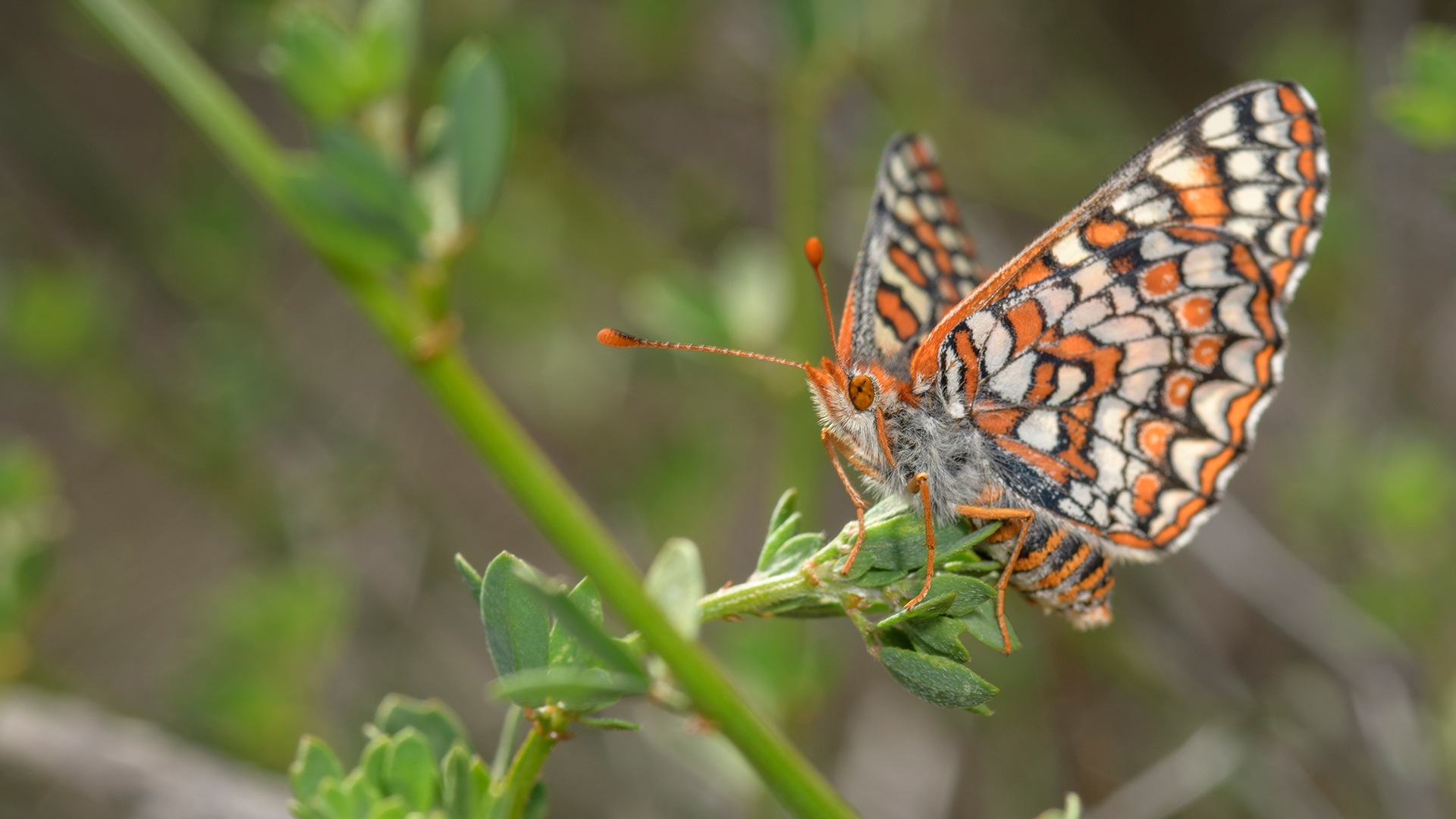
Quino Checkerspot Butterfly

- Class: Insecta (insects)
- Order: Lepidoptera (butterflies and moths)
- Family: Nymphalidae
- Genus: Euphydryas
- Species: Euphydryas editha (Edith’s checkerspot)
- Subspecies: Euphydryas editha quino
ABOUT
The Quino checkerspot is a small butterfly with a wingspan of only 1.5 inches across. The wings are rounded and have a checkered pattern of black, orange, red, and white on both sides. The abdomen has red stripes on top.
The Quino checkerspot is a member of the brush-footed butterfly family. The name comes from special front legs that have brushlike sensory structures instead of feet. They were once one of the most common butterflies in Southern California, but were classified as endangered in 1997, joining a growing list of insects on the federal endangered species list.
HABITAT AND DIET
The Quino checkerspot can live in a variety of habitats—including grasslands, coastal sage scrub, chaparral, woodland, and scrubland—as long as there are open areas with an abundance of sun and native host plants. In San Diego, the California dotseed plantain Plantago erecta is their primary host plant. Quino checkerspots can maintain a larger, more stable population by having a group of smaller, connected populations in the surrounding area. These smaller populations fluctuate and may die out if the area proves unfavorable, but these movements are necessary because the Quino checkerspot requires a large number of plants for feeding.
Quino checkerspot larvae feed on the leaves of plantain, purple owl’s clover, and other native plants, while adults feed on flowering nectar plants. Individual larva can consume several hundred plantain seedlings each, so they need access to a significant plant population to get enough nutrients. The ideal habitat for Quino checkerspots will include these plants, as well as bare patches for basking in the sun and soil conditions that hold moisture and extend the life of the host plants. Plantain has a very short growing season and only lives about 1–2 months, so larvae feed constantly until the host plant dies back. At that time, the young larvae enter a period of dormancy called diapause.
LIFE STAGES
The Quino checkerspot goes through 4 life stages: egg, larva (caterpillar), pupa (chrysalis), and adult. Adult Quino checkerspot butterflies emerge in the spring and live 10–14 days, but their emergence is staggered, so their overall flight period is 4–6 weeks. During their flight period, males establish territories to attract mates, and females mate and lay eggs. Females lay large clusters of eggs in sun-facing host plants. The eggs that survive to maturity will hatch about 10–14 days later.
For about the first 10 days of their life, larvae will group together to spin protective webs and feed. They spend up to 2 weeks in their webs before moving to other plants, where they continue feeding until temperatures get warmer and they enter diapause.
During diapause, larvae enter a state of rest that lowers their metabolic rate to a point where they are less sensitive to temperature changes. Most wildlife enter diapause in winter, but Quino checkerspots enter diapause in summer. This adaptation is very specific to the climate in Southern California and lets them wait out the hot, dry summers and reemerge with the winter rains (typically in November or December). Depending on rain levels and other environmental triggers, larvae will come in and out of diapause to feed on their host plant until they are able to complete their development into adult butterflies. Because of this, it can take several years for the Quino checkerspot to fully transition from larva to winged adult butterfly.
After emerging from diapause, larvae seek areas with high levels of sun exposure, which helps speed their development. Depending on various factors, the time between the end of diapause and pupation can range from 2 weeks to 2–3 months, unless the larva reenters diapause. Larvae go through several molting periods before entering their brief pupa phase. Adult butterflies emerge after about 10 days.
CONSERVATION
Formerly one of the most common butterflies in Southern California, the Quino checkerspot now inhabits only a few areas. Their historical range included coastal areas from Southern California down through northern Baja California, Mexico, but they lost almost 20% of their habitat in 2003 due to wildfires. Remaining populations were threatened by habitat fragmentation and degradation caused by urban development, increased frequency of wildfires, pesticide spraying, and invasive species. By the time the Quino checkerspot was listed as endangered in 1997, more than 75% of its historical range had been lost. Significant areas of remaining Quino checkerspot butterfly habitat are now protected through preserves.
Since 2012, San Diego Zoo Wildlife Alliance has worked with partners like the U.S. Fish and Wildlife Service to protect and restore populations of endangered Quino checkerspot butterflies through our Southwest Conservation Hub. In the spring, care specialists from the San Diego Zoo gather adult Quino checkerspots, bring them to the Zoo’s Butterfly Conservation Lab, collect thousands of their eggs, and release them back into the native habitat where they were found. The eggs and larvae are carefully tended until they are large enough to be released into different areas of their native habitat, supporting the growth of both their population and their habitat usage. The release of 1,500 larvae in 2016 was the first time this species had been hand-raised and released into native habitat; between 2017–2022, an additional 14,000 larvae were released within 5 diverse habitats. These releases help boost local populations and support this vital species within its historic range.
San Diego Zoo Wildlife Alliance has also developed a new larval release method using special metal mesh “release pods.” When the larvae are ready to live outside the Butterfly Conservation Lab, they are moved into the pods, which are taken to native habitat areas and anchored to shrubs next to plantain plants. The pods are strong enough to protect the larvae from larger predators, but still open to natural elements, allowing the larvae to experience and respond to weather and other environmental cues and decide when they are ready to emerge into the nearby plantain. The pods also enable more consistent monitoring and data collection, which has greatly increased the understanding of this species. Our goal is to increase existing populations and restore habitat to ensure the population within San Diego County continues to maintain this species for years to come. This will help support the greater long-term goal of seeing the Quino checkerspot butterfly removed from the federal endangered species list.
By supporting San Diego Zoo Wildlife Alliance as an ally for wildlife, you are helping save species worldwide. Learn more at sdzwa.org/conservation-landing.