
Pancake Tortoise

- Class: Reptilia (Reptiles)
- Order: Testudines
- Family: Testudinidae
- Genus: Malacochersus
- Species: tomieri
ABOUT
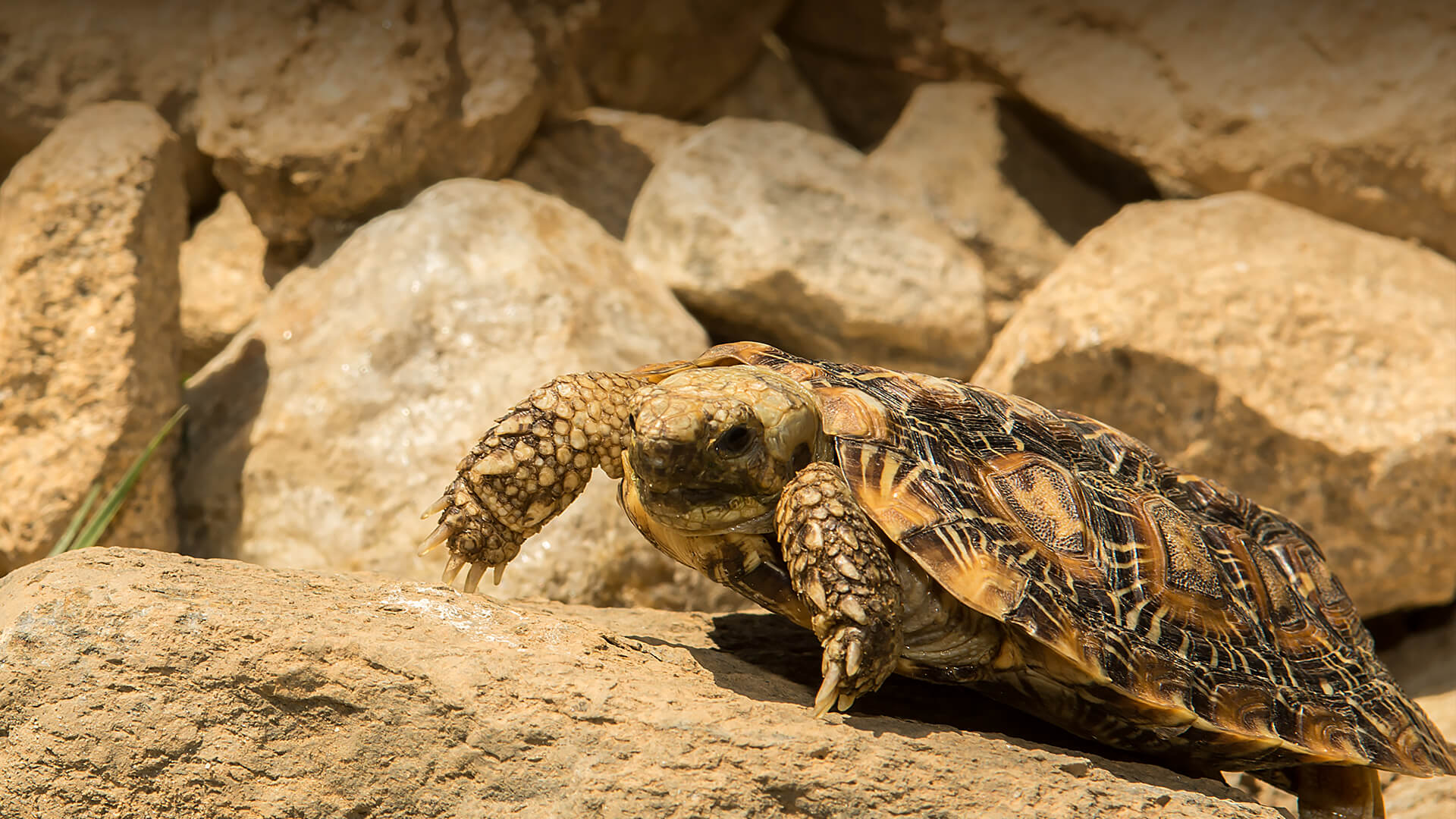
Flat, fast, and flexible. The pancake tortoise is unique in the tortoise family, physically and behaviorally. Its shell is unusually thin, flat, and flexible, helping make the pancake tortoise the fastest of the tortoises. While most other tortoises have solid structural shells, there are many holes in the shell of the pancake tortoise, making it lightweight and agile. In fact, instead of hiding in its shell for protection, the pancake tortoise is able to quickly flee from danger. The flexibility of this shell allows pancake tortoises to crawl into narrow rock crevices, enabling them to use a habitat that is not suitable for any other tortoise. Unfortunately, these peculiar adaptations make pancake tortoises sought after for the illegal pet trade, making them vulnerable to extinction. Wildlife should never be taken from its native range.
HABITAT AND DIET
Pancake tortoises live in arid savannas and scrublands of East Africa. They also like kojpe habitat, which consists of rocky outcrops. They are found living is isolated colonies. Pancake tortoises are native to southern Kenya, and northern and eastern Tanzania. An introduced population is found in Zimbabwe.
These tortoises have a brown shell with vibrant yellow markings—ideal for blending into their habitat. The body of the tortoise is a light brown color.
Pancake tortoises feast on dry grasses and most other vegetation. They will take advantage of fallen fruit, and even indulge on succulents such as aloe.
FAMILY LIFE
These tortoises are most active in the morning and early evening. This is when they venture out to find food and bask in the sun for warmth. They never stray too far away from their shelter. They only surface from rocky crevices for an hour or so at a time, to stay safe from danger.
Breeding season is January and February. In managed care, this varies, and tortoises may breed year-round. Females will lay one egg at a time in loose, sandy dirt from June to August. The shallow holes for incubating the eggs are about 4 inches (10 centimeters) deep.
Females are able to produce more eggs during the summer—typically four to six weeks after laying one egg. The sex of the offspring is temperature dependent. The hatchings are a mere 1 to 2 inches (2.5 to 5 centimeters) long and are independent as soon as they hatch. There is no parental care.
CONSERVATION
The biggest threats to pancake tortoises are habitat destruction and the illegal pet trade. In Kenya, they are losing habitat to agricultural development. In Tanzania, overgrazing is a problem. Appropriate habitat is not common or widespread; this species is classified as Critically Endangered on the International Union for Conservation of Nature (IUCN) Red List of Threatened Species.
The physical attributes of this tortoise are so unique that, unfortunately, they are sought for the illegal pet trade. Populations harvested for the pet trade consist of juveniles, thereby isolating populations in native areas. Wildlife trafficking not only adversely affects the species involved, it also impacts the local ecosystems.
Fortunately, protective measures were taken. Trade in pancake tortoises is restricted by the Convention on International Trade in Endangered Species of Wild Fauna and Flora (CITES). Conservation breeding programs are underway in zoos including the San Diego Zoo, where wildlife care specialists ensure that the eggs are incubating at the proper temperature for the sex needed for the growth of this population. San Diego Zoo Wildlife Alliance is committed to combating illegal wildlife trafficking; and the San Diego Zoo and Safari Park are safe havens for wildlife caught up in the trade.
By supporting the Alliance, you are our ally in saving and protecting wildlife worldwide.