
Komodo Dragon

- CLASS: Reptilia (Reptiles)
- ORDER: Squamata
- FAMILY: Varanidae
- GENUS: Varanus
- SPECIES: komodoensis
ABOUT
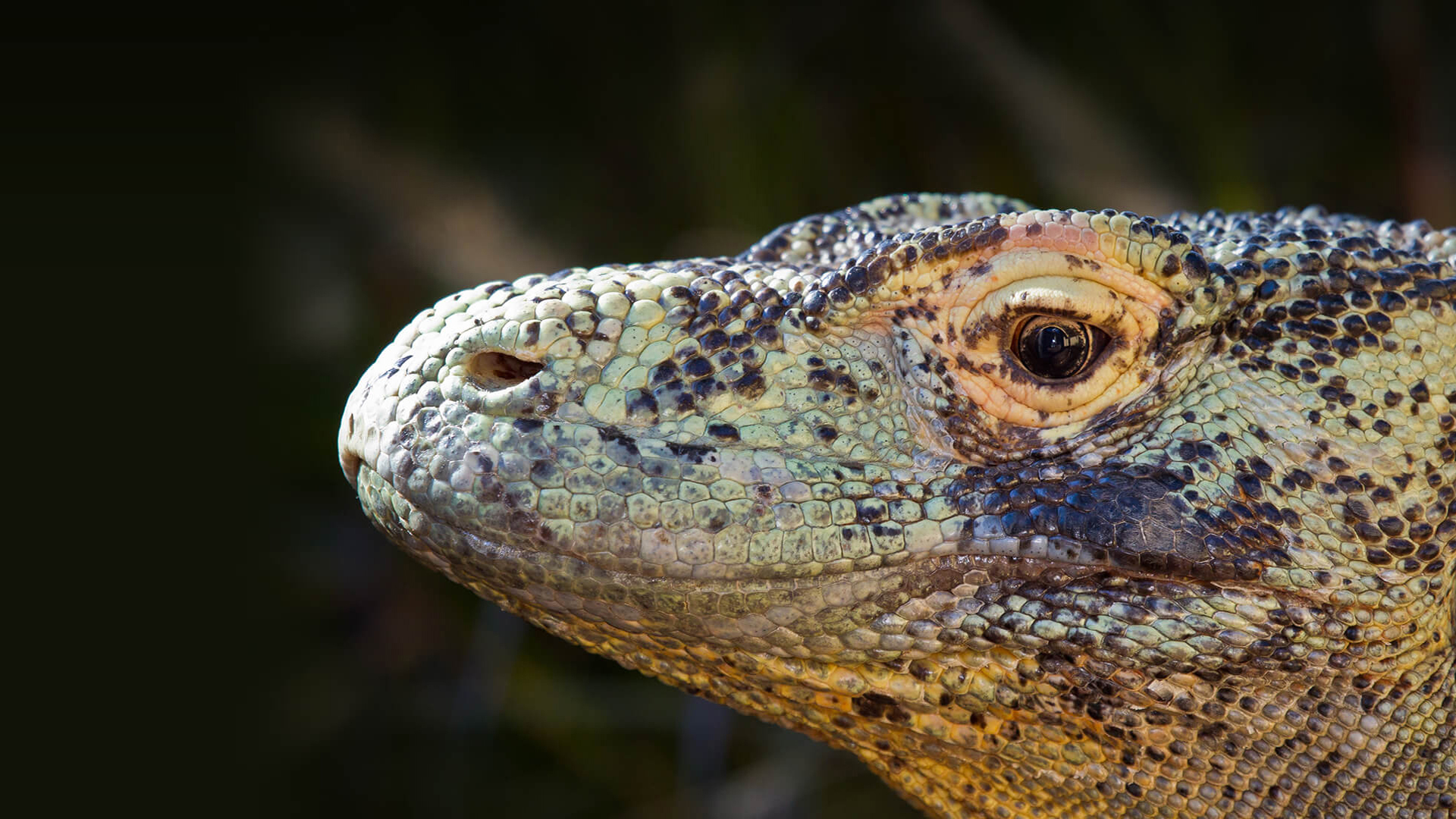
There are over 3,000 lizard species, but the Komodo dragon wins the prize for being the largest living lizard in the world. It is a type of monitor lizard, an ancient group of reptiles with ancestors that date back more than 100 million years. Komodo dragons weren't formally documented as a new species until 1910, and their common name came from rumors of a large dragon-like lizard inhabiting the Lesser Sunda Islands in Indonesia. Indeed, the yellow color of the Komodo dragon’s long, forked tongue reminds people of mythical dragons that spit fire.
These large lizards range in color from black to yellow-gray, depending on their location, and have a rough, durable skin reinforced with osteoderms (bony plates), protecting them from injuries like scratches and bites. Komodo dragons also have a large, muscular tail; long, powerful claws; and move with impressively fast bursts of speed.
HABITAT AND DIET
Komodo dragons have the smallest home range of any large predator in the world. It is estimated that today’s population is confined to less than 350 square miles (900 sq km) across six islands clustered together in Indonesia. As of 2021, it is estimated that about 3,500 adult and juvenile Komodo dragons are currently living there, separated into eight subpopulations across just six islands: Flores, Gili Motang, Komodo, Nusa Kode, Padar, and Rinca. While three of the subpopulations live on Flores, almost 70% of the total population resides between Komodo and Rinca.
The islands are volcanic in origin; they are rugged, hilly, and covered with both forest and savanna grassland. Daytime temperatures during the dry season often reach 95 degrees Fahrenheit (35 degrees Celsius) with 70% humidity. Some Komodo dragons scratch shallow burrows to keep warm at night and as a cool shelter to retreat to from the heat of the day. They may either make their own burrows or use an existing one another lizard created. Sometimes these burrows can be seen along the slopes of dry streambeds among tree roots.
An adult Komodo dragon emerges from from its burrow to look for a sunny spot to warm up in. Then it’s off to find breakfast, followed by a nice long nap in the shade during the hottest part of the day. After a late afternoon meal, the Komodo returns to its burrow until a new day begins. It is a solitary individual that lives and hunts alone.
An adult Komodo dragon eats whatever prey is available, including Timor deer, water buffalo, and wild pigs, as well as snakes and fish that wash up on the shore. Young Komodos spend their lives in trees, which helps reduce their risk of predation. They eat any prey fits into their mouth, including eggs, grasshoppers, beetles, and geckos. When they are about 4 years old and 4 feet long (1.2 meters), Komodo dragons are large enough to try life on the ground.
FAMILY LIFE
Like many reptiles, the number of Komodo dragon females that nest every year often changes due to the availability of prey and the physical condition of the female. Female Komodos do not breed every year. During these “rest” years, females recover from the energy costs incurred by their bodies from egg production during fertile years.
Female Komodos use three different nest types for their eggs: hillside nests, ground nests, and mound nests built by the orange-footed scrub fowl. Females often dig decoy nest chambers to discourage predators, including male Komodos and other female dragons, from disturbing existing nests sites when digging their own nests.
The orange-footed scrub fowl builds nests made of leaves and debris, forming a natural incubator from the heat produced from the decomposing leaves. It is easy to distinguish the source of nest-building activities, as the scrub fowl nests from January to April, while the female Komodo dragons’ nest digging occurs in August and September. One study indicated that female Komodo dragons showed a marked preference for selecting mound nests over hillside and ground nests.
Komodo dragons begin their life in an egg the size of a grapefruit. The female lays between 20 and 30 eggs and guards her nest and eggs for the first few months. Life for a young Komodo dragon is not easy. As soon as the baby hatches, it scrambles out of the nest and scurries up the nearest tree to stay safe from predators.
AT THE ZOO
In 1968, the San Diego Zoo became one of the first conservation organizations in the United States to house Komodo dragons. These reptiles have been charismatic ambassadors for their species, inspiring wildlife allies to discover more about them and the unique island ecosystems of their native habitats. Being able to learn from Komodos every day, in a way that wouldn’t be possible on remote Indonesian islands, also allowed wildlife health and care experts to explore new strategies that promote healthy, sustainable populations of Komodo dragons worldwide.
In the mid-1990s, the San Diego Zoo found an easy and safe way to determine the sex of Komodo dragons at a young age. Previously, Komodo dragons weren’t sexed until they reached reproductive maturity at about 8–10 years old. Because of this, it wasn’t uncommon for Komodo dragons to be paired for mating, only to find they were both males or females. Using minimally invasive blood samples and ultrasound exams, the Zoo was able to determine the sex of Komodo dragons once they were 2 years old—a major development for Komodo population sustainability initiatives. The same method was later proven to be accurate for monitor lizards, Gila monsters, and beaded lizards, improving reproductive outcomes for many reptiles in human care and leading the way for additional advancements. Today, a Komodo’s sex can be determined by extracting blood from eggs after just 260 days of incubation.
Komodo dragons thriving at the Zoo receive regular wellness exams, which include checking their weight. We’ve found they gain weight quickly, which can cause degenerative bone problems. The Zoo’s Jennings Veterinary Hospital also completes regular computed tomography (CT) scans on the Komodos; very few zoos are able to do this, and we openly share this information, providing insights for zoos all over the world. By utilizing this knowledge, along with what has been observed in the hunting and travel patterns of Komodos in native habitats, we can optimize the well-being of Komodos in human care and ensure there is a vibrant, genetically diverse global population.
Come experience Komodo dragons for yourself at Kenneth C. Griffin Komodo Kingdom or the Reptile House at the San Diego Zoo.
CONSERVATION
Some might think the largest lizard in the world wouldn’t have to worry about its safety, but the magnificent Komodo dragon is endangered. From 1981–2021, their numbers dropped from 5,000 to 3,500—a 30% decline in just 40 years, triggering a reclassification of the species from vulnerable to endangered by the International Union for Conservation of Nature. Due to habitat loss and fragmentation, there is very little breeding between subpopulations, which reduces the genetic diversity necessary to sustain healthy global populations. While there is currently no concern for habitat loss within Komodo National Park boundaries, Komodos are still threatened by human activities, including illegal wildlife trafficking and relying on the same prey as local people and introduced feral dogs. And the Komodos on Flores—outside of the park’s protective boundaries—are increasingly impacted by habitat loss and challenges coexisting with people; it is estimated that no more than 10% of the Flores subpopulation lives within a protected area. It is also predicted that between 30–70% of Komodos’ native range could be lost by 2040 due to rising sea levels.
Despite the relatively small population size and limited native range of Komodo dragons, the separation of the subpopulations between isolated, rugged islands made it difficult to consistently check and report on their well-being without extensive resources and knowledge. Effectively surveying these reptiles required the dedication of researchers and conservationists from organizations around the world. Since the 1990s, San Diego Zoo Wildlife Alliance has funded the travel of conservation and population sustainability experts to Indonesia to support local efforts to protect Komodo dragons. What we and our partners have uncovered there—combined with what we’ve learned from caring for Komodos at the San Diego Zoo—resulted in groundbreaking discoveries that helped stabilize Komodo numbers and establish strategies for protecting their environment so they can continue capturing imaginations for generations to come.
San Diego Zoo Wildlife Alliance works to protect Komodo dragons and their native habitats through our Asia Conservation Hub. Read more about the groundbreaking work being done by San Diego Zoo Wildlife Alliance and our conservation partners worldwide on our Story Hub.