
Antelope

- Class: Mammalia (Mammals)
- Order: Artiodactyla
- Family: Bovidae
- Subfamily: Antilopinae
ABOUT
What IS an antelope? The word antelope has been used to describe a wide variety of horned mammals in the Family Bovidae. There are even some species within the Bovidae family that are known as goat-antelope! This page will focus on some of the species in the Antilopinae subfamily, commonly called antelope as well as those such as impalas, gazelles, and gnu or wildebeest. Be sure to see Goats & Sheep, Oryx, and Nile Lechwe to read about other Antilopinae subfamily members.
Horns or antlers? All antelope have horns; in some species they are only found on the males, whereas in others, such as gazelles, both males and females have them. The horns are made of a bony core encased in a hard material made largely of keratin (the same substance our fingernails are made of!). Horns are permanently attached, unlike a deer’s antlers, which are shed each year.
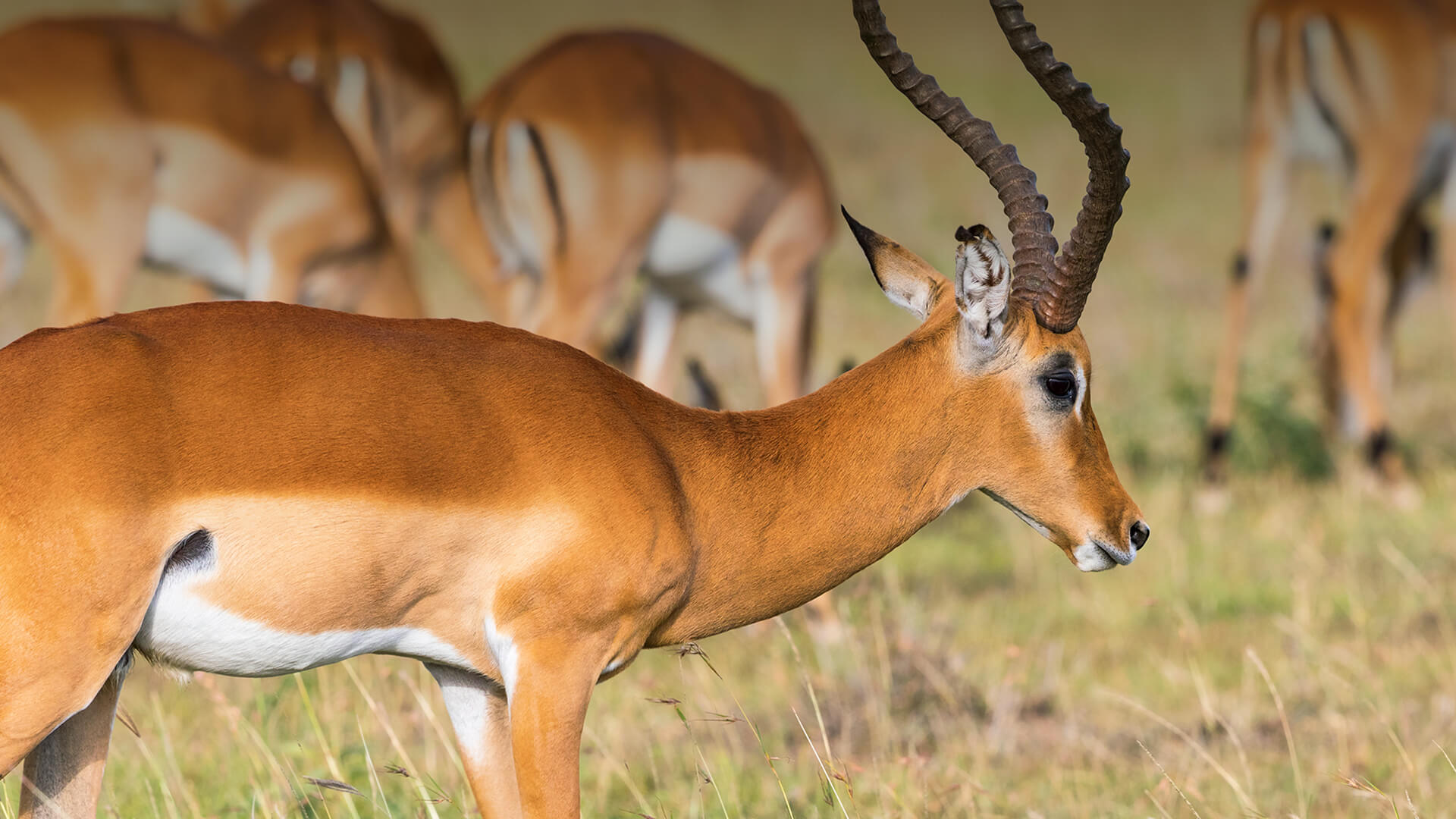
Some horns, like those of the addax and blackbuck, twist in interesting spirals; others are ridged or corrugated, like those of the impala and the sable antelope; still others grow in wide curves with a sharp point on the end, like those of the gnu.
These hooves are made for walkin'. Hooves are another specialty for many antelope. Each hoof has a split down the middle, dividing the hoof into two toes. Lechwes, which live in swampy areas, have long, pointed hooves to give them sure footing in the water. Slender-horned gazelles have sturdy, wide hooves for walking on the shifting sand of their desert habitat. And klipspringer have tiny, rounded hooves with a pad in the center that acts like a suction cup, allowing these nimble antelope to hop from rock to rock without falling.
What's the plan? Antelope must always be on the lookout for danger, as they make a hearty meal for many predators—leopards, lions, civets, hyenas, wild dogs, cheetahs, and pythons—depending on species and location. Large birds of prey may take young calves. But antelope do have some ways to keep safe.
Freeze Frame: When a Maxwell’s duiker sense danger, it freezes, often with one leg off of the ground, so as not to be noticed.
Alarm calls: Maxwell’s duikers use two vocalizations: an alarm whistle and a loud bleat; klipspringer make a loud, shrill whistle. A rhebok sentinel or lookout stays on guard and alerts its group with a cough-like grunt if a threat is discovered.
Running: Yellow-backed duikers dart with great speed into the protection of dense vegetation. A threatened gerenuk lowers its head and neck, and then either slowly creeps away or makes a fast dash for survival. Although rheboks tend to run from danger, males have been seen attacking and chasing baboons.
Jumping: Springbok and beira escape with bounding leaps that often confuse a predator giving chase. Gazelles have a stiff-legged jump called a stot.
Hiding: Lechwes spend their life near water and can jump in and swim away if they feel threatened. They also hide in water, with only their nose sticking out. Royal antelope try to stay hidden to avoid trouble. Steenbok often hide, lying flat against the ground with their neck outstretched—they won’t run away until the predator is about to step on them!
Odor: It is said a waterbuck’s body odor alone deters most predators.
Horns: Don’t forget those horns—antelope can use their sharp horns to defend themselves if needed.
Marking turf. Both male and female antelope have scent glands used for leaving hints of their presence. You can easily see one of these scent-marking tools by looking at their face: just in front of each eye is a pit-like opening, called a preorbital gland. Fluid secreted from this spot is wiped on grass, twigs, tree trunks, logs, stones, and even other members of the group to mark territory. Other scent glands are hidden beneath tufts of hair on the knees and between their split hooves. Duikers press their face gland on each side of an individual of the opposite sex in a behavior called mutual marking.
What did you say? Different types of antelope also make different sounds that may include bleats, bellows, grunts, moos, and more. A gerenuk’s main call sounds like a combined grunt and moan; a squeaky snort means the gerenuk is annoyed by something, while a buzzing sound means that they are alarmed. The gnu gets its name from its call, which sounds like “ge-nu.” Several antelope species make a warning or threat noise that sounds like a dog’s bark.
The super-sized snout of the male saiga may play a role in communication: males with the largest nose may be able to make low-frequency calls that indicate vigor to competitors.
HABITAT AND DIET
At home on the range. The majority of antelope are native to Africa, but there are some living in the Middle East and Asia. Most live in open grasslands, but the smaller duikers, most sunis, and royal antelope live in Central Africa’s rainforests or wooded areas, dik diks live in arid bush country with heavy vegetation, and mountain sunis dwell in the highland forests of southern Kenya. Waterbuck, as their name suggests, and lechwe are never far from water.
In territorial antelope like sable antelope, waterbuck, bontebok, and gazelles, the males choose a particular piece of habitat and defend it from other adult males of their kind. Herds of females and their young can come and go freely, although in the breeding season, the male tries to keep them in his territory. If he has a stream or shady tree in his area, he’s more likely to keep the females around. Males that are not quite full-grown or that have not established a territory form bachelor herds.
Meals to go. Antelope are herbivores, with an odd exception: some duiker species have been known to kill and eat insects, small mammals, and birds. Otherwise, antelope tend to browse on bushes and smaller trees or graze on grass. Some antelope switch back and forth, eating whatever is most nutritious or what’s available during dry or cold times of the year.
Some antelope have special feeding adaptations for their environment. The addax follow the rains, traveling great distances to eat the new plant growth. Thomson’s gazelle follow herds of migrating gnu and zebra, which eat the tougher layer of grass and leave the shorter, more tender shoots behind. Duiker often follow bird flocks or monkey troops to take advantage of the fruit they drop. Royal antelope wander the woods at night looking for succulent leaves, fruits, and fungi to eat on the forest floor.
Perhaps two of the oddest-looking antelope are gerenuk and dibatags, both of which have slender bodies, long thin legs, and very long necks. They can stand upright on their hind legs and stretch up with that long neck to eat leaves that other wildlife can’t reach!
At the San Diego Zoo and San Diego Zoo Safari Park, antelope eat an herbivore pellet diet and various browse material.
FAMILY LIFE
Who are you? The social life of antelope depends a lot on the type of habitat they live in and how much food and water is available. We tend to think of antelope living in big groups, but not all form large herds. Duikers and dik diks live alone, in pairs, or in small groups of between 3 and 10 individuals. Dik dik pairs choose a territory and may occupy and defend that same territory for life.
Have you "herd"? Some antelope are famous for their massive herds, like the thousands of gnu making their annual migration across the African plains. Impalas, springbok, and saigas also form very large herds during migratory seasons when they are on the move to find the best food. Many antelope that live in large groups at least part of the year also have special scent glands on their hooves, so they leave the herd’s scent on the ground for any stray members to find.
The males are not usually territorial at these times, but they leave the herd during the breeding season and stake out a territory where they compete for females. They may also use size or strength displays or threaten with their horns to determine which male is dominant and to keep females.
Baby on board. Antelope calves have two survival strategies: hide out to avoid predators or start traveling right after birth to join the protection of the herd. The majority of antelope use the hiding approach, including roan antelope, waterbuck, klipspringer, and duikers.
In some antelope that live in groups, the mother, called a dam, goes away from the herd to give birth, and when the calf is strong enough, she moves it to another location where there are bushes, long grass, rocks, or a thicket to hide the youngster from predators. The dam then rejoins the herd, and the calf remains hidden and quiet. She comes back periodically to feed her calf, calling softly to it and listening for the bleat.
Between a week and a month or more, depending on the species, the calf then joins the herd and may be put with the other calves in what’s known as a nursery group. In more solitary antelope, the dam hides her calf and then stays nearby to guard it as she feeds, returning to nurse it when needed. When the calf is strong enough, it joins her, and they stay together until the calf is mature and heads out on its own.
In antelope that migrate or live on large ranges, like hartebeest, topis, bontebok, and gnu, the calves are up and on their feet within a few minutes to a day or so after they are born, and they immediately start traveling with the herd. They often stick together as a group and are protected by adults surrounding them. This way they don’t get left behind and can nurse from their mothers. If danger approaches, the adults can face the challenge with their strength and their horns.
CONSERVATION
Threats. One major threat to virtually all antelope is hunting, for both horns and meat. However, culture and human attitudes toward these animals vary. For example, in Sierra Leone, the royal antelope Neotragus pygmaeus is rarely shot, but it can get caught in snares set for duikers and other hoofed animals. In Liberia, there are widespread taboos on the hunting or eating of the royal antelope among the country’s ethnic groups. In contrast, the royal antelope makes up a significant part of the bushmeat trade in Côte d’Ivoire.
The saiga Saiga tatarica, addax Addax nasommaculatus, dama gazelle Nanger dama, Hunter's antelope Beatragus hunteri, and Aders' duiker Cephalophus adsersi are at critical risk, and several other antelope are endangered.
Saiga saga. Saigas are poached for their horns, which are highly valued in traditional Asian folk remedies. As with rhino horn, the demand far outpaces the supply, driving prices up and making poaching seem worth the risk. The impact has been jaw dropping: in 1994, there were about 1,350,000 saigas in Russia; today, there are a mere 65,000, with very few males, since poachers, who are mainly interested in the horns, take only the males.
The San Diego Zoo Safari Park had a breeding herd of saigas, with over 100 calves born, setting a record among zoos. That experience was put to use to help the struggling populations in the wilderness. San Diego Zoo Wildlife Alliance currently provides funding and expertise to saiga conservation efforts at the Center for Wild Animals and the Stepnoi Reserve in Russia. Some of the saigas born at the Center have been reintroduced into the Reserve, where they are watched over by trained rangers.
To help the rangers help the saigas, we provide funds for vehicles, spotting scopes, and gasoline, so the rangers can effectively patrol the Reserve to watch the health of the herds and address the poaching problem. To combat poaching, young male saigas born at the Center have their horns removed before reintroduction, and efforts are being made to inform community members about the saigas’ plight. Education is a key component of the conservation efforts, and a Visitor’s Center now hosts programs about saigas for schoolchildren.
You can help us protect antelope by supporting San Diego Zoo Wildlife Alliance. Together we can save wildlife worldwide.