
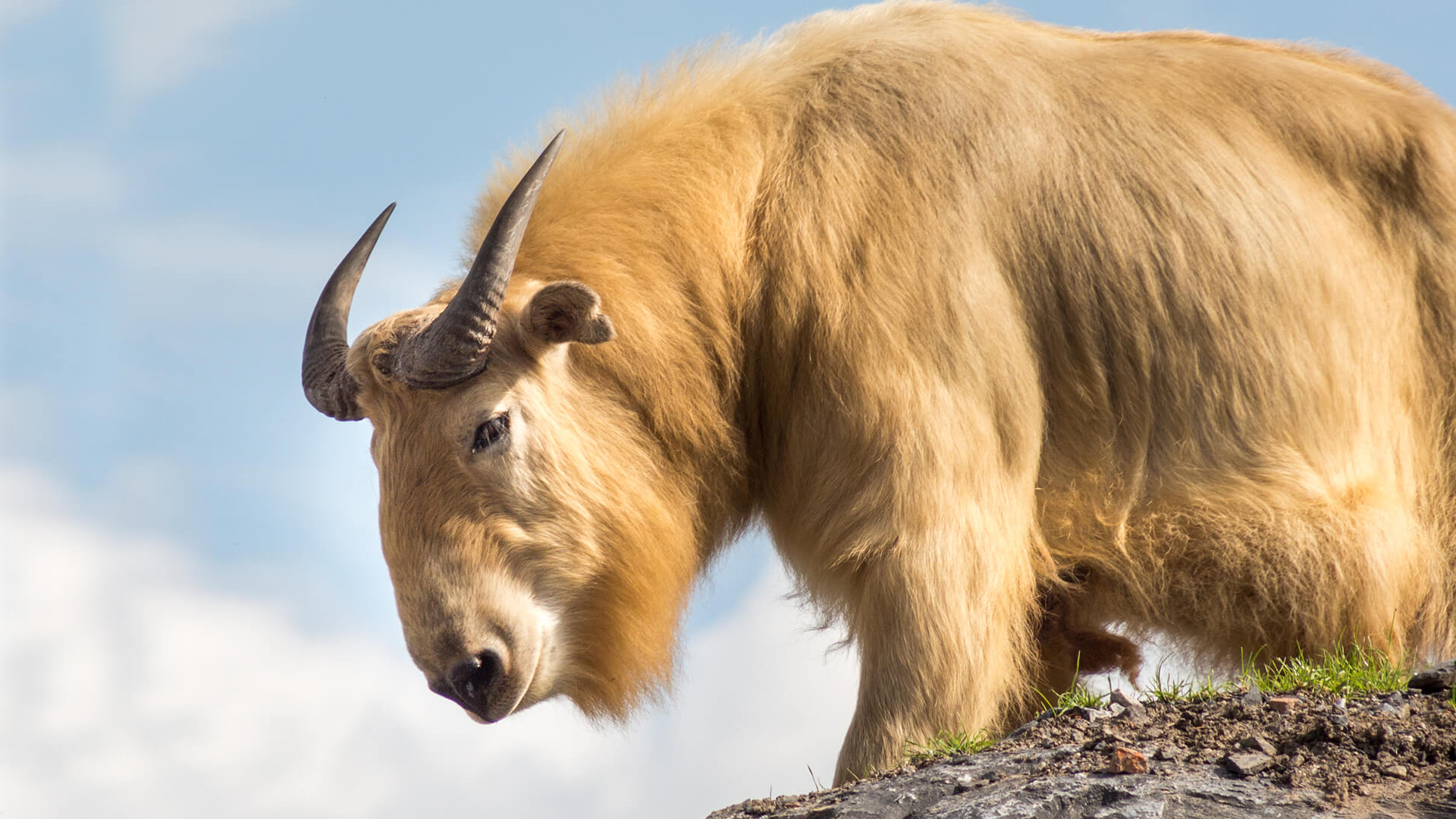
Takin

- CLASS: Mammalia
- ORDER: Artiodactyla
- FAMILY: Bovidae
- GENUS: Budorcas
- SPECIES: taxicolor
- SUBSPECIES: bedfordi (Shensi or golden takin), taxi color (Mishmi takin), whitei (Bhutan takin), tibetana (Sichuan takin)
ABOUT
With horns like a wildebeest, a nose like a moose, a tail like a bear, and a body like a bison, a takin (rhymes with rockin') truly represents nature's creativity. These large, muscular, hoofed mammals are sometimes referred to as "goat antelope" because they share characteristics with both goats and antelopes. But takins are actually most closely related to sheep, specifically Barbary sheep, of North Africa.
Because of their large, powerful bodies and impressive horns, takins have few natural predators other than bears, wolves, leopards, and dholes. They are generally slow moving but can react quickly if angered or frightened. When needed, takins can leap nimbly from rock to rock. If they sense danger, takins warn others with a loud "cough" that sends the herd running for cover in the dense underbrush, where they lie down to avoid detection. Takins can also make an intimidating roar or bellow.
HABITAT AND DIET
Takins have adaptations to help them stay warm and dry during cold winters in the rugged Himalayan Mountains. They grow a thick, secondary coat just for the winter, which they shed for the summer. They also have a very noteworthy nose! Their large, moose-like snout has big sinus cavities to warm up the air they inhale before it gets to their lungs. Without this adaptation, takins would lose a large amount of body heat just by breathing. Although takins have no skin glands, their skin secretes an oily, bitter-tasting substance that acts as a natural raincoat in storms and fog. Streaks of this oily stuff can be seen where takins rub up against the sides of rocks.
Split hooves help takins move around easily in their rocky habitat. They also have an odor that smells like a strange combination of horse and musk. Both males and females have shiny black, crescent-shaped horns that grow from the center of their massive head and can reach up to 35 inches (90 centimeters) in length.
Each spring, takins gather in large herds and migrate up the mountains to the tree line, an altitude above 14,000 feet (4,300 meters). As cooler weather approaches and food becomes scarce, takins move down to forested valleys. As they move up, down, or across the mountains, takins use the same routes over and over. This creates a series of well-worn paths through the dense growths of bamboo and rhododendrons that lead to their natural salt licks and grazing areas.
Takins eat many kinds of alpine and deciduous plants and evergreens. When it comes to food, takins munch on almost any vegetation within reach. This includes the tough leaves of evergreen rhododendrons and oaks, willow and pine bark, bamboo leaves, and a variety of new-growth leaves and herbs. They can easily stand on their hind legs, front legs propped against a tree, to reach for higher vegetation if they need to. If the tastiest leaves are out of reach, takins have been known to use their powerful bodies to push over small trees to bring those leaves closer!
Like cows and sheep, takins are ruminants and pass food into their first stomach, called the rumen, when they first swallow it. Microbes in the rumen help digest very small particles of food. Larger particles pass into a second chamber that regurgitates these particles, called cud, back into their mouth to be chewed into pieces small enough to be digested properly. Takins naturally eat in the early morning and again in the late afternoon. They spend the day under the cover of dense vegetation, venturing into the open only on cloudy or foggy days. When takins aren’t eating, they’re usually resting. A takin sleeps with its head resting on top of its extended front feet, almost like a dog!
Takins at the San Diego Zoo eat grass hay and browse on a variety of fresh vegetation like acacia, bamboo, Chinese elm, mulberry, and more.
FAMILY LIFE
The size of a takin herd changes with the seasons: during spring and early summer, herds can number up to 300 individuals; during cooler months, when food is less plentiful, large herds break up into smaller groups of 10 to 35 takins as they head up the mountain. Herds are made up of adult females (called cows), kids (which is what takin young are called), subadults, and young males. Older males, called bulls, are generally solitary except during the rut, or mating season, in late summer. While young takins butt their heads with each other for fun, bulls butt heads to establish dominance.
Mostly solitary, bull takins meet up with herds for a short time during the rut. They bellow loudly to attract cows and notify other bulls of their presence. They may find takin cows by tracking their scent. Once they meet, a bull sniffs and licks a female to determine if she is receptive.
Takin cows seek out areas of dense vegetation to give birth to a single kid in early spring (twins are rare). Within three days of birth, a takin kid can follow its mother through most types of terrain. This is critical if bears or wolves are nearby or if the herd needs to travel a long distance for food. If a kid gets separated from its mother during the first two weeks, it gives a panicked noise that sounds like a lion cub! The mother answers with a low, guttural call that brings the kid running back to her.
At birth, takin kids are much darker than adults to give them camouflage from predators; they even have a dark stripe along their back that disappears as they get older. Their coat gets lighter in color, longer, and shaggier as they mature. A takin kid eats solid food and stops nursing around two months old, and grows horns around six months old. Kids are much more playful than their parents. They kick up their heels, head butt, and frolic with each other. A kid may stay near its mother until after her next calf is born.
For the most part, takins are fairly quiet, but they do make some interesting noises, from snorts to deep, bugle-like notes and loud whistles. A guttural burping sound means they want something. A deep noise that sounds like “whup” is a warning or for asserting dominance. A mother may call to her kid with a high-pitched “rrr” sound, and males can make a resounding, guttural bellow during fights with other males. A loud “cough” sends the herd running for cover.
Takins also convey information using a variety of body postures. These visual displays are an important way takins communicate with each other. For example, a male shows dominance with an erect posture and a raised neck and chin. He might position his body sideways to another takin to emphasize his size. A takin signals aggression with a head-down posture, holding its neck horizontal and rigid, with its head and horns hooked to one side. A lowered head, an arched back, snorting, and head crashing often follow prolonged eye contact between individuals.
The scent of another takin’s skin or urine offers information, too. In particular, pheromones in a takin’s urine may advertise sexual status and identity. To enhance this type of communication, a male sprays his own forelegs, chest, and face with urine. A female soaks her tail when she urinates.
CONSERVATION
Like giant pandas, Sichuan takins are highly regarded in China and have the highest level of legal protection there. India, Bhutan, and China all have laws prohibiting takin hunting, but despite their size and defenses, some people hunt takins regularly for their meat, both within and outside protected areas. Many people are unaware of the conservation laws that are in place to protect takins, and in many remote areas, there is no enforcement of the laws. Overhunting has resulted in the disappearance of takins in some areas of their range, and recovery is slow.
Habitat loss also contributes to their declining populations. Farming, mining, pasture burning, cane and bamboo cutting, and road construction have destroyed large areas of takin habitat. As populations of people expand, they encroach on areas occupied by takins. Sometime these activities also fragment the remaining habitat, disrupting migration routes and dividing takin herds. Domestic livestock trample vegetation, compete for food, and transmit diseases to takins.
A 2010 study of Mishmi takins in the eastern Himalayas suggested that takins are especially vulnerable to climate change. Declining snowfall and melting glaciers may decrease the growth of alpine grassland and scrub. Ultimately, climate change could alter the existing mix of wildlife in all takins’ habitat. China has given takins full protection under Chinese law, and two reserves have been created for the protection of Sichuan takins.
San Diego Zoo Wildlife Alliance is helping protect takins. We are one of five members of the Conservation Centers for Species Survival (C2S2), a group devoted to endangered species study, management, and recovery. Collectively, we have significant wildlife health and care expertise, specialized care centers, and decades of experience caring for wildlife in a variety of settings. To study the ecology and behavior of Sichuan takins, C2S2 developed radio-telemetry techniques and observed eight takins in the forests of Tangjiahe Nature Reserve through radio signals, providing information on their seasonal movements, preferred habitat, and natural behaviors. Such knowledge is critical for developing a long-term conservation plan for takins. The San Diego Zoo's conservation breeding program for takins has also helped bring new hope to this threatened species. The work we do for takins is helping scientists better understand how to protect them in their native habitats; however, we still have much to learn.
By joining San Diego Zoo Wildlife Alliance as an ally for wildlife, you help save species worldwide.