
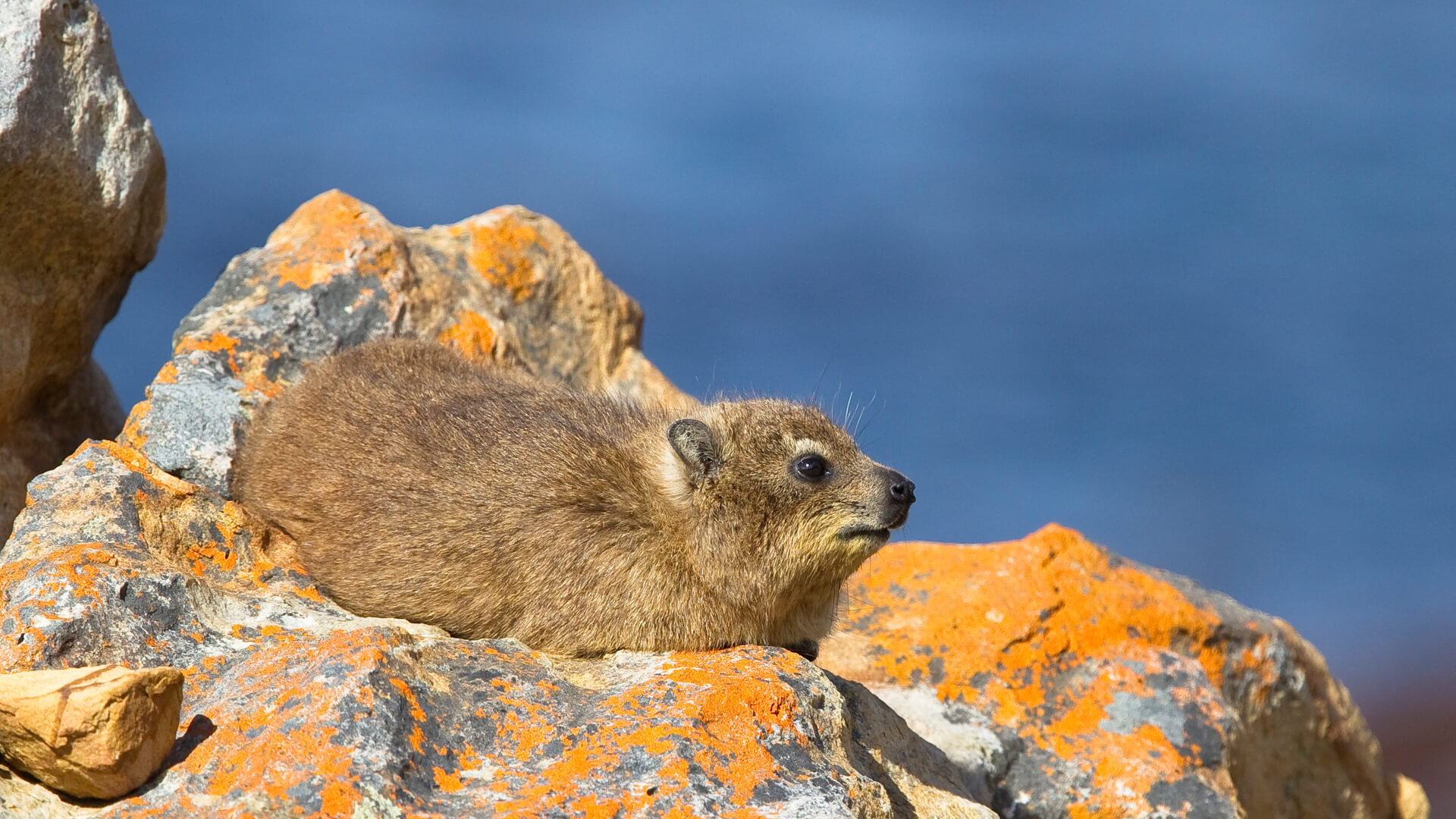
Rock Hyrax

- CLASS: Mammalia (Mammals)
- ORDER: Hyracoidea
- FAMILY: Procavidae
- GENUS: Procavia
- SPECIES: capensis
ABOUT
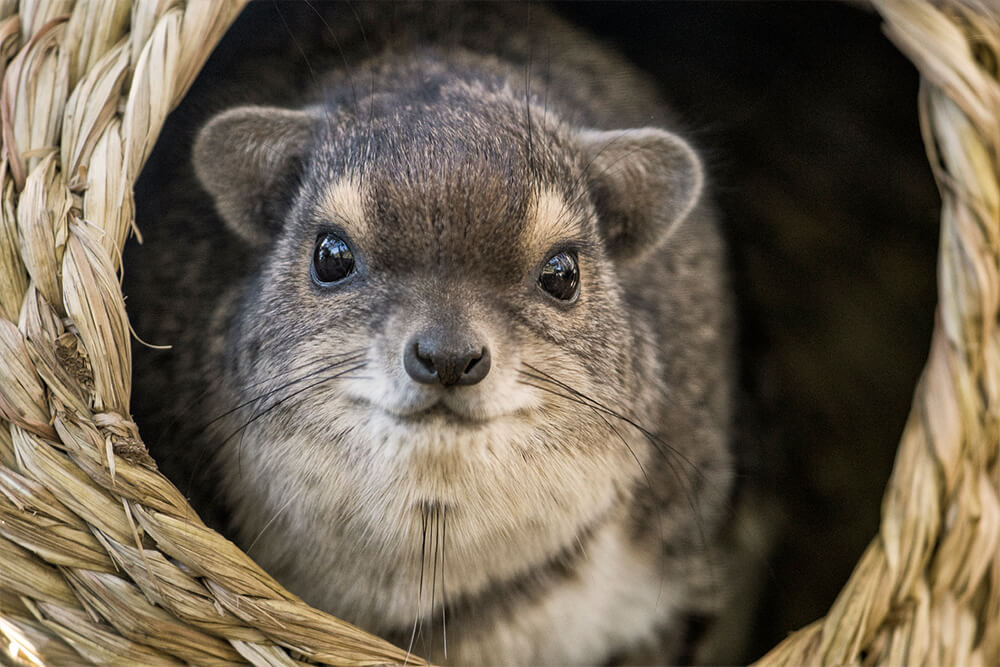
Little brother of the elephant: What is one of the closest living relatives of the elephant? If you said the manatee or dugong, which are both marine mammals, you would be correct. But there is another family member that is often forgotten: the hyrax (HI-racks)!
It might look a bit like a large guinea pig or rabbit with very short ears, but the hyrax is neither. Instead, the hyrax has similar teeth, toes, and skull structures to that of an elephant’s. More importantly, the hyrax shares an ancestor with the elephant. The hyrax’s strong molars grind up tough vegetation, and two large incisor teeth grow out to be tiny tusks, just like an elephant’s.
There are three members of the Procaviidae or hyrax family: the rock hyrax, tree hyrax, and bush or yellow-spotted hyrax. The rock hyrax is covered in short brown fur, with a lighter underbelly. There are extra-long hairs that stick out around the body called guard hairs to help the hyrax feel its way around, the same way a cat uses its whiskers. The hyrax has short legs and rounded toes with a long nail, called a grooming claw, on the inner toe of the back foot that is used for picking through hair and scratching an itch.
A scent gland on its back (called a dorsal gland) is covered with longer black hairs. The gland is used to mark rocks or trees to communicate with other hyraxes. A male hyrax’s nose is larger than a female’s. All hyraxes have a special eyelid (called a nictitating membrane) for sun and dust protection; a bulge in each iris acts as a built-in sun visor.
HABITAT AND DIET
Life on the rocks: All hyraxes live throughout most of Africa, but rock hyraxes are also found along the coast of the Arabian Peninsula up to Lebanon. As their name implies, they hang out in areas where there are boulders, rock formations, or even little nooks on sheer cliffs that provide shelter and protection. Their homes are easy to identify as hyrax abodes, as rock hyrax urine crystalizes and looks like white patches on the rocks.
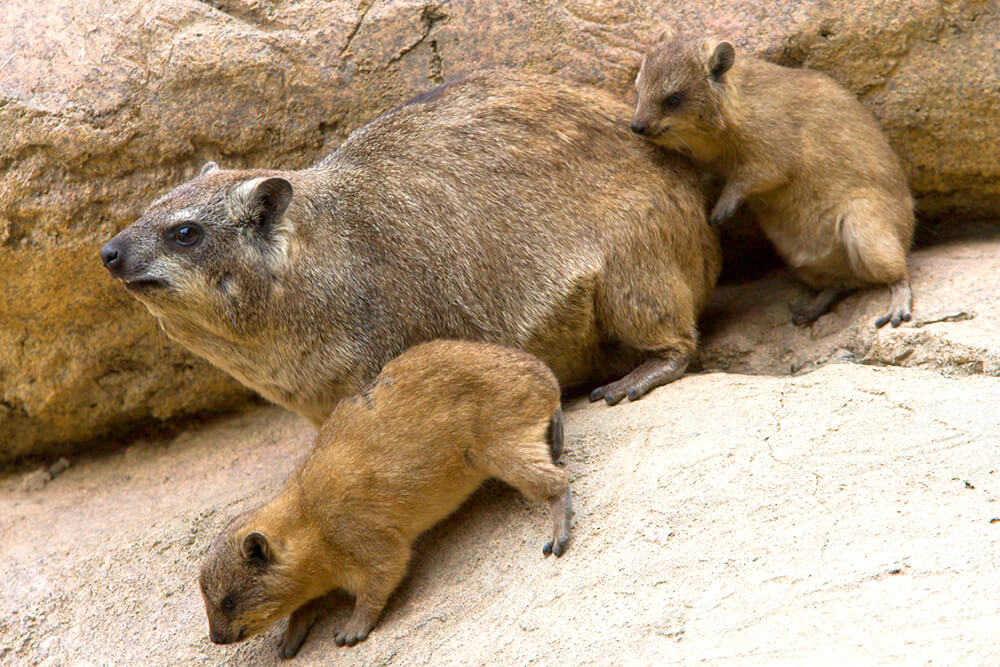
Hyrax feet are built for rock climbing: the bottom of each foot is bare and has a moist, rubbery pad that lifts up in the center for a suction-cup effect to help the hyrax cling to rocks and other smooth surfaces without slipping. They can even “chimney” up and down tight spaces.
Rock hyraxes live up to the expression “safety in numbers.” They may live in colonies of up to 50 individuals, sharing sleeping areas and looking for food together. Each day starts with a group sunbathing session for several hours. Once warmed up, they head out for a short period of feeding. Rock hyraxes do not like cool or rainy weather and won’t even come out of their rock shelter if the weather is not to their liking.
Although diurnal, they may venture out on moonlit nights. They spend most of the time, however, doing nothing; only about five percent of their time is spent in active pursuits.
In some parts of Africa, bush hyraxes often live in the same rocky areas as rock hyraxes. The two species may share shelter holes and huddle together to warm up in the morning. Their young even play together! Although they have very different breeding behaviors, rock hyraxes and bush hyraxes seem to understand each other. There are very few cases of two different mammal species living so closely together.
Hyraxes have a three-chambered stomach with bacteria to help digest the plants they eat. During the wet season, rock hyraxes eat mostly grass, but when the grass dries, they switch to browse materials: fruits and leaves. At the San Diego Zoo, our rock hyraxes are offered super high-fiber pellets, a bit of produce, and hay.
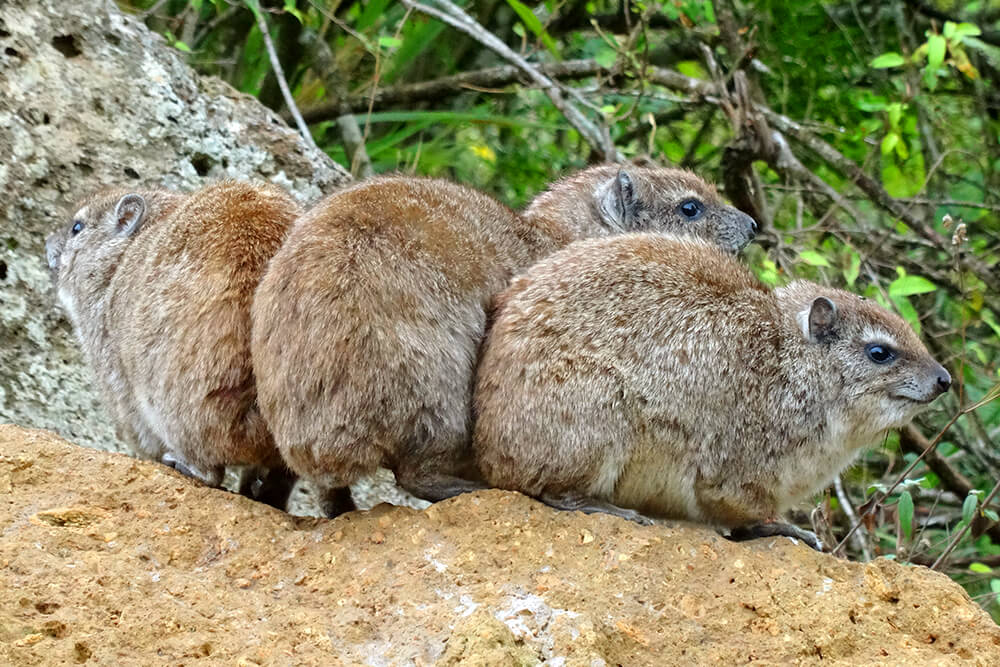
Rock hyraxes feed in a circle formation, with their head pointing to the outside of the circle to keep an eye out for predators, such as leopards, hyenas, jackals, servals, pythons, and the Verreaux’s eagle and black eagle, hyrax specialists.
With their excellent vision, rock hyraxes can spot a predator over 1,000 yards (900 meters) away! During each feeding period, the dominant male pauses between bites to watch for danger. He sounds a shriek alarm if he sees anything of concern, which sends all of the hyraxes scrambling for cover, where they remain absolutely still until they think the danger has passed. If needed, a hyrax can wedge itself backward between rocks and bite savagely at the intruder with its long, sharp incisors.
FAMILY LIFE
Female rock hyraxes stay with their family for life. There is one male for every five to seven females that patrols a certain territory within his colony. When babies, called pups, are born, usually around the same time once each year, the entire colony greets and sniffs the young ones. The pups are amazingly precocial, born with their eyes and ears open. They look like miniature adults and have the same luxuriant coat.
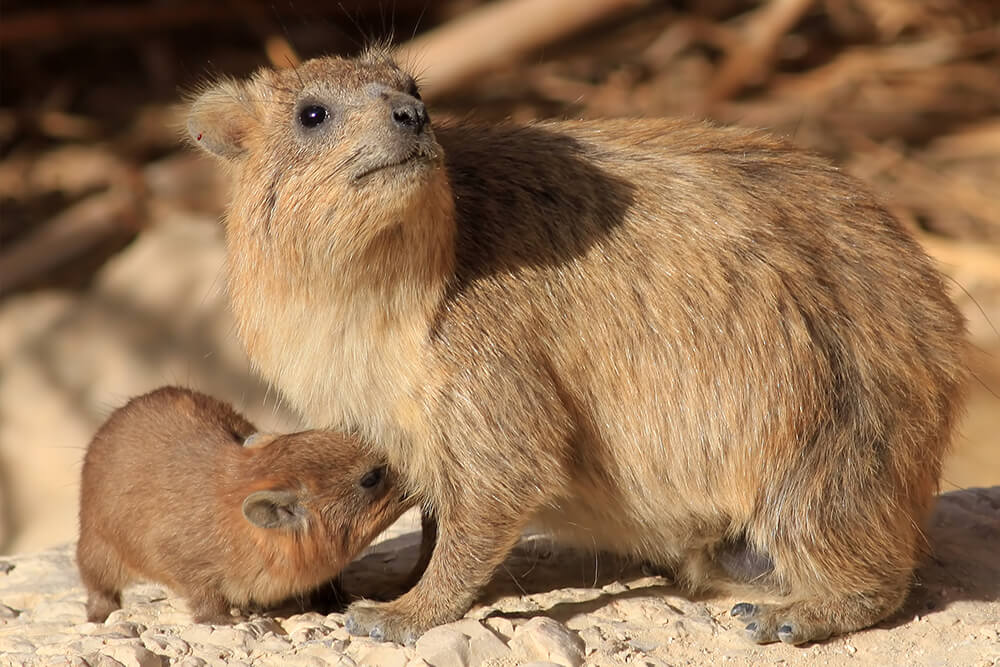
Nursery groups are formed for all the babies, with mothers taking turns watching the little ones. Within three days of birth, the babies are already trying out solid foods and are not just relying on Mom’s milk. To get the bacteria their stomach needs to help digest plants, the babies also eat hyrax poop!
In the first few weeks to months of birth, the young learn from their mother, siblings, and other group members by watching and then repeating the actions they see. When Mom starts to eat succulent plants, her babies start nibbling on the same plant after watching her. They also learn how to interact with other hyraxes and avoid predators through this learning style. By six months of age, they are weaned. Males leave the colony at about two years of age to go live on the outskirts of another colony and perhaps take it over one day.
Hyraxes use grunts, wails, squeals, snorts, twitters, growls, whistles, and shrieks to communicate. They vocalize to contact groups in different locations, just like we might play a game of Marco Polo in the swimming pool: one calls out and another calls back. A happy, friendly hyrax makes a squeaky whistle sound; a sharp bark is a warning call that danger is near; a low grunt means “Don’t mess with me!” The most common call is a high-pitched, mewing note, which can be heard at great distances and is used to indicate the individual’s location.
Hyraxes raise the hairs on their dorsal gland to show aggression or excitement. They like to touch each other’s gland when huddling.
CONSERVATION
Rock hyraxes are not considered endangered and have become as common as our North American squirrels. As a result, they are considered pests in some areas, competing with farmers by eating freshly planted fields; and competing with cattle, sheep, and goats for grassy grazing sites. They are also hunted for their meat and soft fur, but so far their populations are stable. Mange, a skin disease, is lethal to hyraxes and can wipe out a whole colony. More research is needed to further understand these remarkable little mammals.
By supporting San Diego Zoo Wildlife Alliance, you are our ally in saving and protecting wildlife worldwide.