
Ostrich

- CLASS: Aves (Birds)
- ORDER: Struthioniformes
- FAMILY: Struthiondae
- GENUS: Struthio
- SPECIES: camelus
- SUBSPECIES: camelus (red-necked or North African ostrich), molybdophanes (Somali ostrich), massaicus (Masai ostrich), australis (South African ostrich)
ABOUT
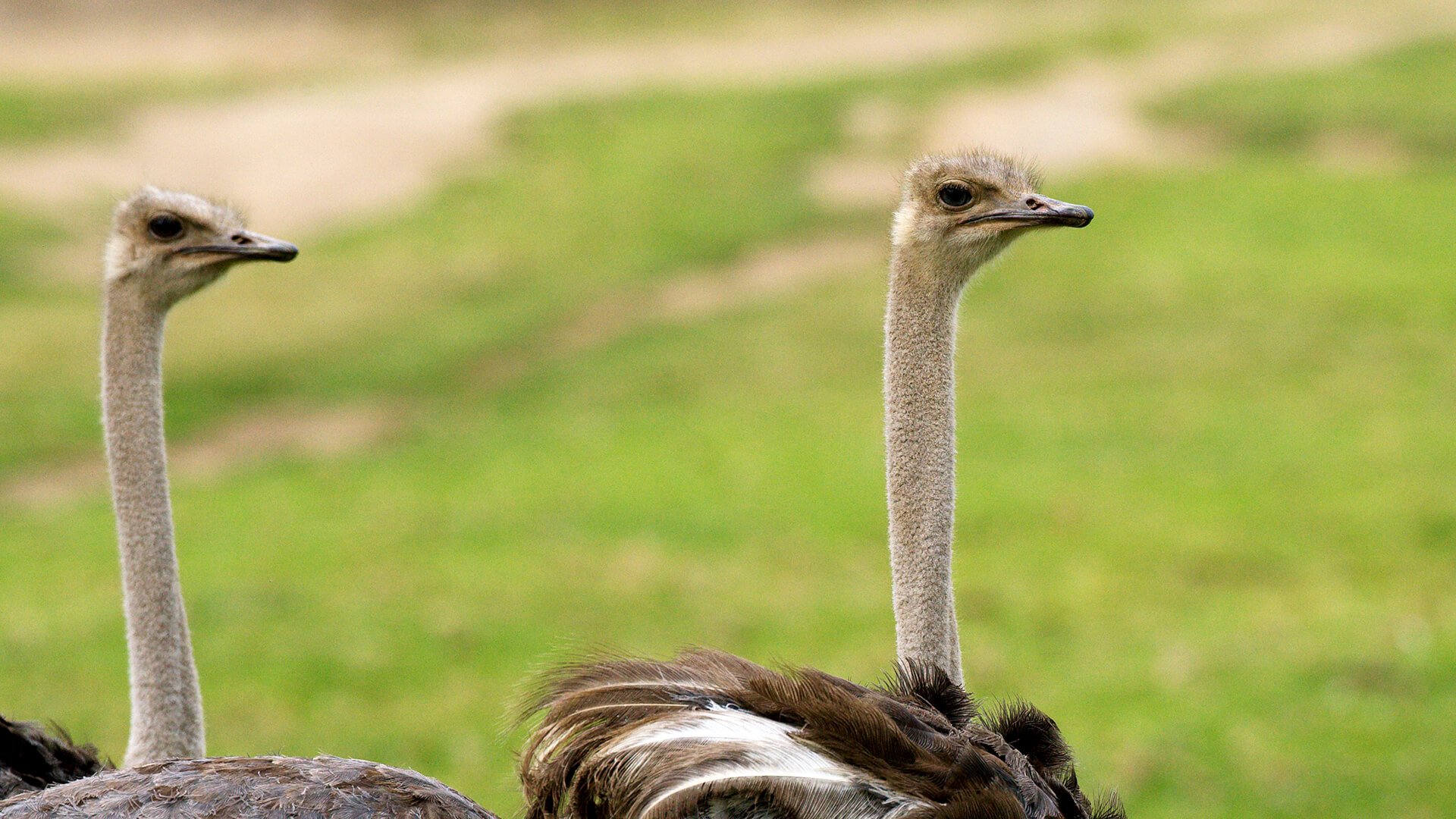
The ostrich is the largest and heaviest living bird. As its species name, camelus, suggests, the ostrich was once known as the “camel bird” because of its long neck, prominent eyes, and sweeping eyelashes, as well as its jolting walk. Also, like camels, the ostrich can tolerate high temperatures and go without water for long periods of time.
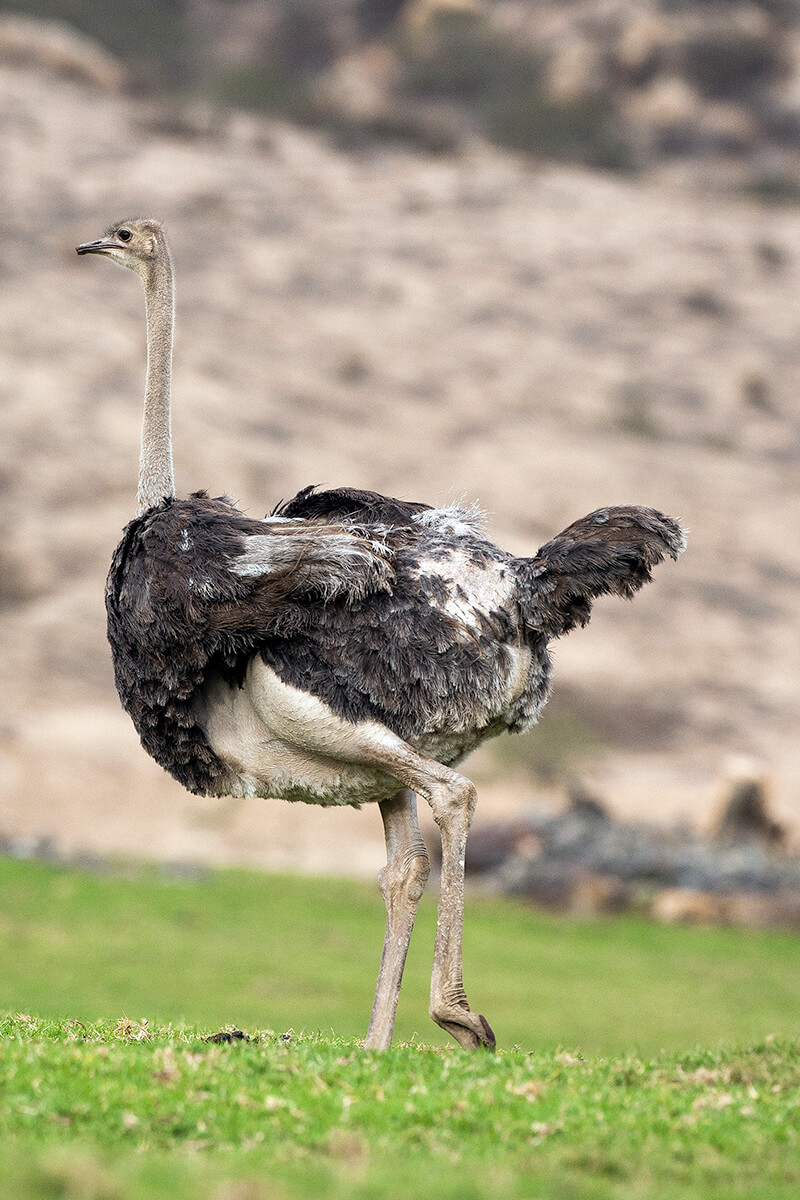
As it is so heavy, this flightless bird that can never take to the skies; instead, it’s built to run. Its long, thick, and powerful legs can cover great distances without much effort, and its feet have only two toes for greater speed.
Ostriches can sprint in short bursts up to 43 miles per hour (70 kilometers per hour), and they can maintain a steady speed of 31 miles per hour (50 kilometers per hour). Just one stride can be 10 to 16 feet (3 to 5 meters) long—that’s longer than many rooms! When danger threatens, ostriches can escape pretty easily by running away. Ostrich chicks can run at speeds approaching 35 miles per hour (56 kilometers per hour) at just a month old!
If they can't fly, why do they have wings? For one thing, ostriches hold their wings out to help them balance when they run, especially if they suddenly change direction. Their main use, though, along with the tail feathers, is for displays and courtship. To show dominance, an ostrich holds its head up high and lifts its wings and tail feathers; to show submission, the head, wings, and tail droop down.
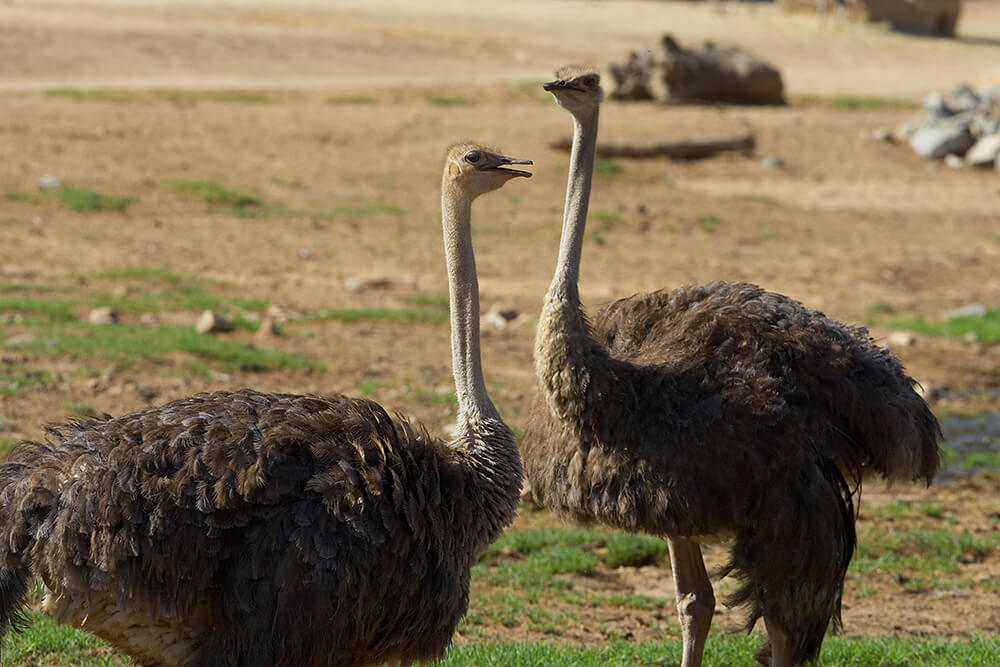
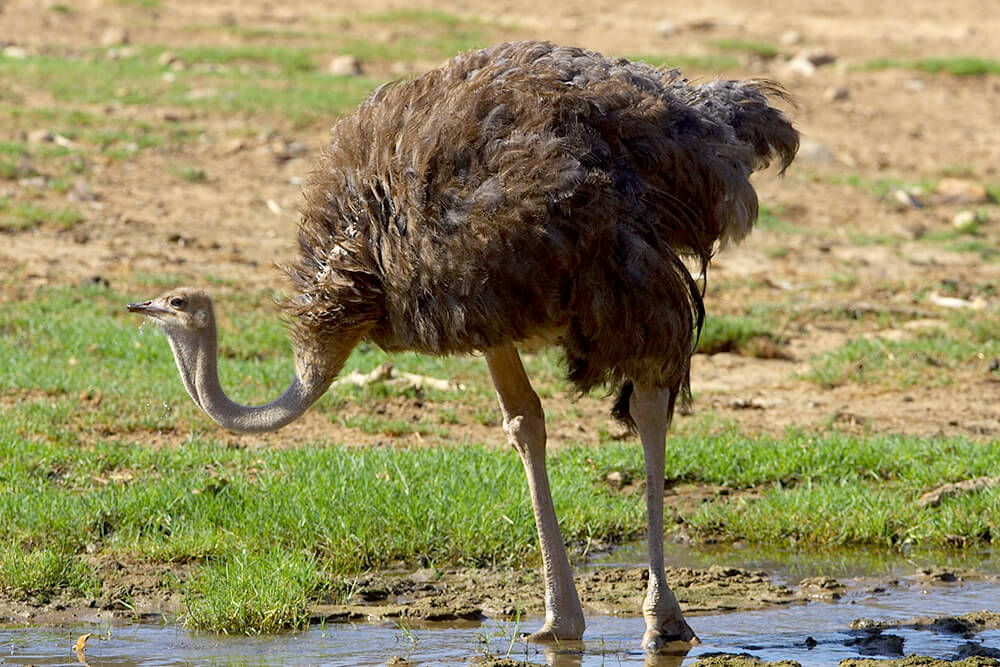
Unlike most birds’ feathers, ostrich feathers are loose, soft, and smooth. They don’t hook together the way feathers of other birds do, giving ostriches a "shaggy" look. The feathers can also get soaked in the rain, because ostriches do not have the special gland many birds have to waterproof their feathers while preening. Adult male ostriches have striking black-and-white plumage; immature birds and adult females have grayish brown feathers.
Ostriches live in groups, which helps with defense. With their long necks and keen vision, they can see for great distances, so in a group at least one of them is likely to notice danger approaching. Ostriches sometimes gather in a large flock of 100 or more, but most flocks are smaller, usually about 10 birds or just a male and female pair. The groups have a pecking order, with a dominant male that establishes and defends a territory, a dominant female called the "main hen," and several other females. Lone males may also come and go during breeding season.
Contrary to the popular myth, ostriches do not bury their heads in the sand! When an ostrich senses danger and cannot run away, it flops to the ground and remains still, with its head and neck flat on the ground in front of it. Because the head and neck are lightly colored, they blend in with the color of the soil. From a distance, it just looks like the ostrich has buried its head in the sand, because only the body is visible. Some ostrich eggs are lost to hyenas, jackals, and even Egyptian vultures, which break open eggs by dropping stones on them. But when an adult ostrich is threatened, it attacks with a clawed foot that delivers a kick powerful enough to kill a lion.
HABITAT AND DIET
Native to Africa, ostriches are found in savanna and desert regions, where they graze among giraffes, zebras, wildebeest, and gazelles. Ostriches are omnivores, and they eat whatever is available in their habitat at that time of the year. They mostly eat plants, especially roots, leaves, and seeds, but they also munch on insects, snakes, lizards, or rodents that come within reach. As an ostrich eats, food is collected in the crop at the top of the throat until there is a large enough lump to slide down the throat.
Ostriches eat things that other animals can’t digest. They swallow sand, pebbles, and small stones that help grind up food in their gizzard. Their tough intestines are 46 feet (14 meters) long—if you stretched them out—in order to absorb as many nutrients as possible. Ostriches do not need to drink water, since they get what they need from the plants they eat, but they will drink if they come to a water hole. They also have a special way of raising their body temperature on hot days to reduce water loss.
FAMILY LIFE
During courtship, the black-and-white male uses his dramatic coloring to attract the light brown female. He sinks slowly to the ground, almost like he’s bowing, and begins to wave and shake the feathers of first one wing and then the other while moving his tail up and down. He then gets up and moves toward the female, holding his wings out and stamping as he goes to impress her. If she approves, she mates with him.
The dominant or "alpha" hen mates with the territorial male, and they share the tasks of incubating the eggs and caring for the chicks. The other females may mate with that male or other wandering males, and then lay their eggs in the same nest as the main hen’s eggs—a communal “dump” nest that is little more than a shallow depression scratched in the dirt by the male. The main hen puts her eggs in the center of the nest to make sure they have the best chance of hatching, but the dominant pair may incubate many of the other eggs, too.
Ostrich eggs are famous for their size, averaging 6 inches (15 centimeters) in length, 5 inches (13 centimeters) across, and weighing about 3 pounds (1,500 grams). Yet an ostrich egg is small in relation to the size of the adult. An ostrich hen lays 7 to 10 eggs at a time, but her large body can easily incubate dozens more. Communal laying has advantages for an ostrich flock: more eggs successfully hatch overall in a communal nest than if each female ostrich had her own nest to incubate and protect. Usually the drab-colored main hen takes incubation duty during the day; the black-plumed male takes over and incubates at night.
Newly hatched chicks are about the size of barnyard chickens, but they grow at a rate of 1 foot (30 centimeters) per month, and by 6 months of age they are nearly as large as their parents. A few days after the chicks hatch, they leave the nest to travel with their parents. The adults shelter them under their wings to protect them from sun and rain. When chicks are threatened, the male ostrich reacts with alarm, his neck outstretched and mouth open. This is not a prelude to an attack but one of several “distraction displays” meant to divert a predator’s attention, so the chicks can scatter into the grass or run for cover, accompanied by the female.
Baby ostriches are covered with a stiff, spiky down and don’t begin to show their adult plumage until four months of age. Male ostriches don’t attain their black-and-white feathers until they reach sexual maturity in three to four years.
When family groups of ostriches meet, they may challenge each other with short chases, and then the winning adult pair takes all the chicks with them. Some of these "nurseries" can end up with 300 chicks and only a couple of adults to mind them.
CONSERVATION
Humans have had a long association with ostriches, due primarily to the birds’ feathers. Records show the ancient Egyptian, Assyrian, and Babylonian empires all actively groomed, farmed, and traded ostrich plumes. Throughout the ages, ostrich feathers have been worn by royalty, adorned the helmets of medieval knights, and festooned the elaborate hairdos of ladies. In the late 18th century, the hat industry brought the fashion for all types of feathers to its zenith and turned the hunting of birds for their feathers into a major global enterprise.
Ostrich plumes were particularly prized. South Africa turned to the commercial farming of ostriches for their feathers. It quickly became a profitable industry; so valuable were ostrich plumes that in the early 20th century, they ranked fourth on the list of South African exports—after gold, diamonds, and wool. By 1913, more than 1 million ostriches lived on commercial farms throughout the world. Then, overnight, the bottom dropped out of the feather market due, surprisingly, to the invention of the car. Early cars had no roof or windshield, and women passengers found their feathers stripped from hats and blown away.
Ostrich farming continues today on a smaller scale, primarily to supply the feather duster industry. Farm-raised ostriches are also harvested for eggs, supple leather, and gourmet meat that is lower in cholesterol than beef.
At one time, most of Africa was home to the ostrich. Today, although not threatened, the ostrich requires strict protection and farming to conserve the remaining populations.
By supporting San Diego Zoo Wildlife Alliance, you are our ally in saving and protecting wildlife worldwide.