
Giant Panda

- CLASS: Mammalia (Mammals)
- ORDER: Carnivora
- FAMILY: Ursidae
- GENUS: Ailuropoda
- SPECIES: melanoleuca
ABOUT
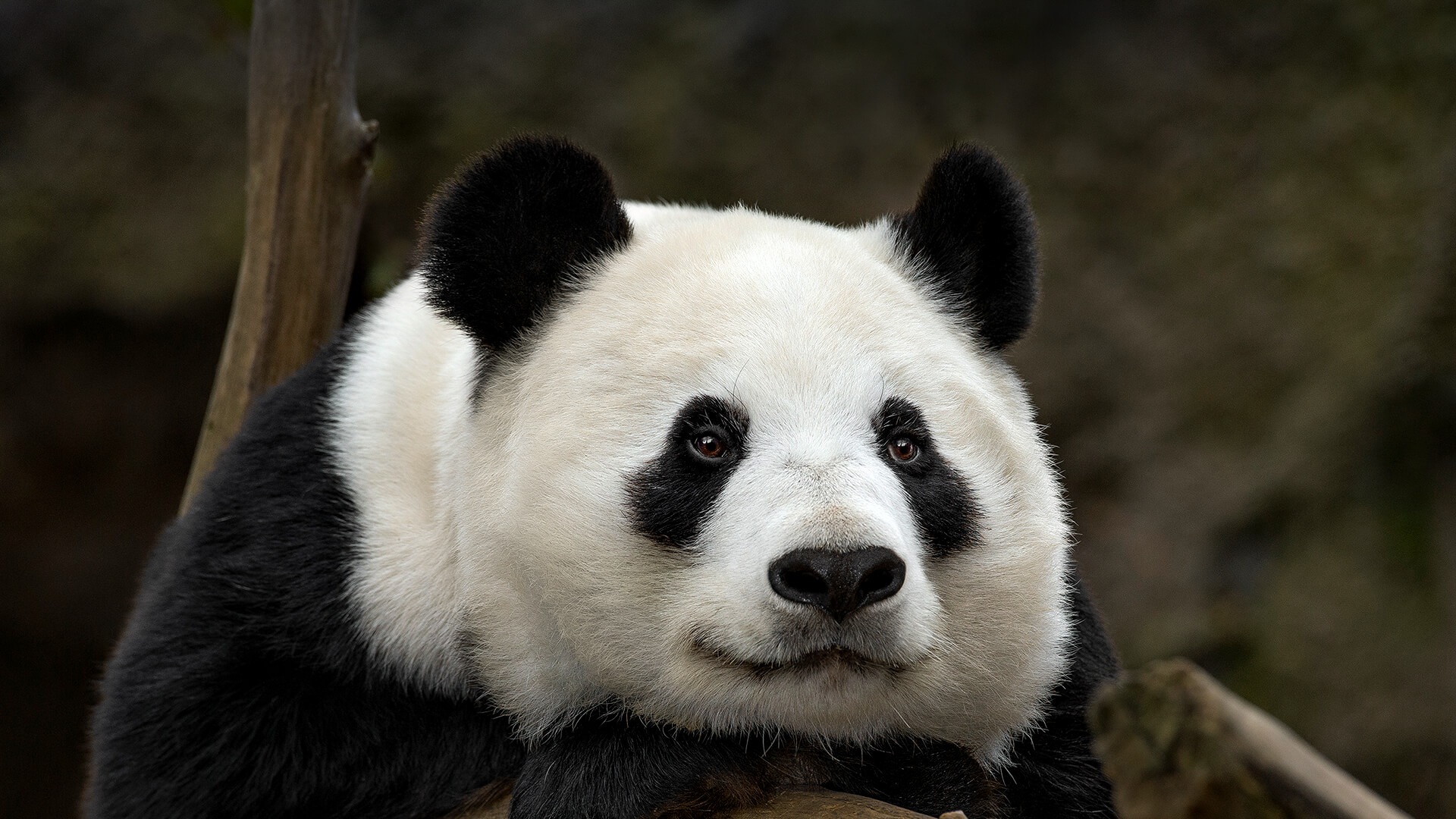
Giant pandas are black and white and loved all over. Giant pandas have become national icons in China and are protected by law in their native bamboo forests. These unique bears have long been revered and can be found in Chinese art dating back thousands of years. Chinese common names for giant pandas can be translated as "large bear-cat" and "bamboo bear."
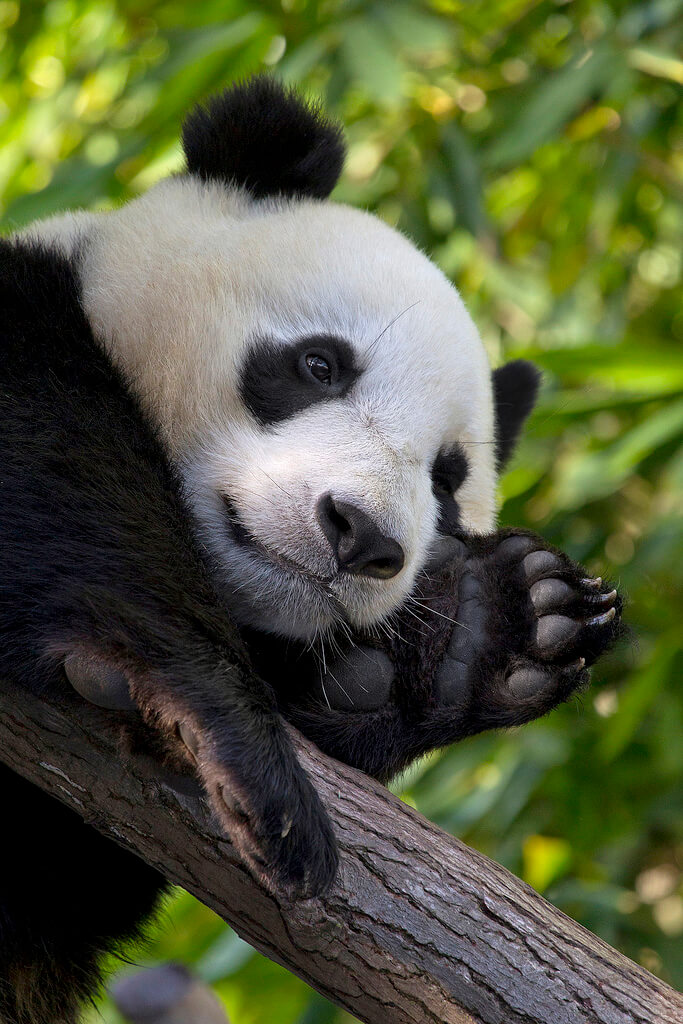
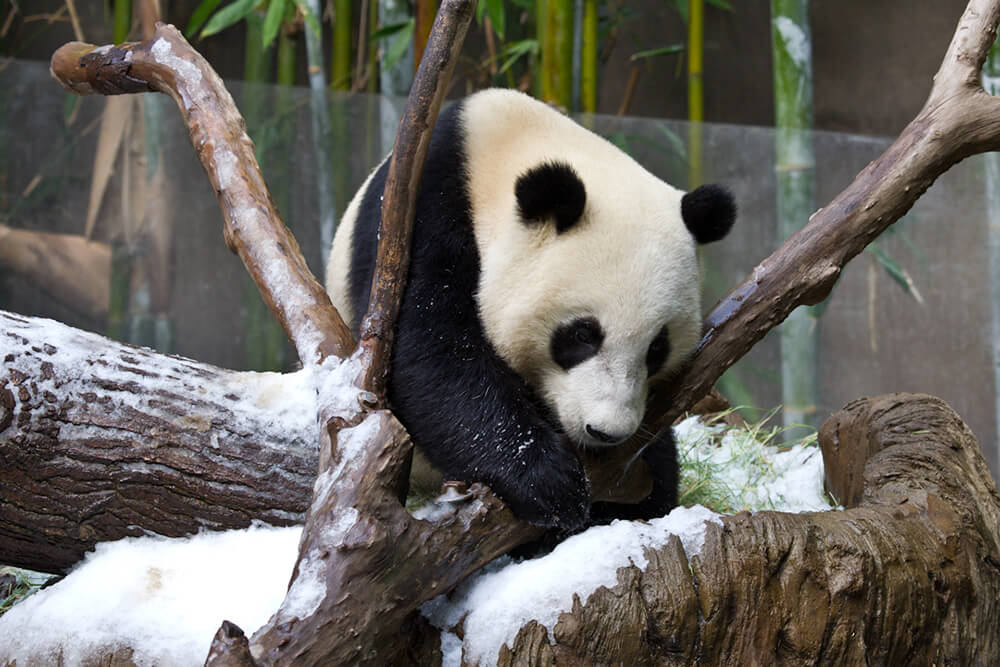
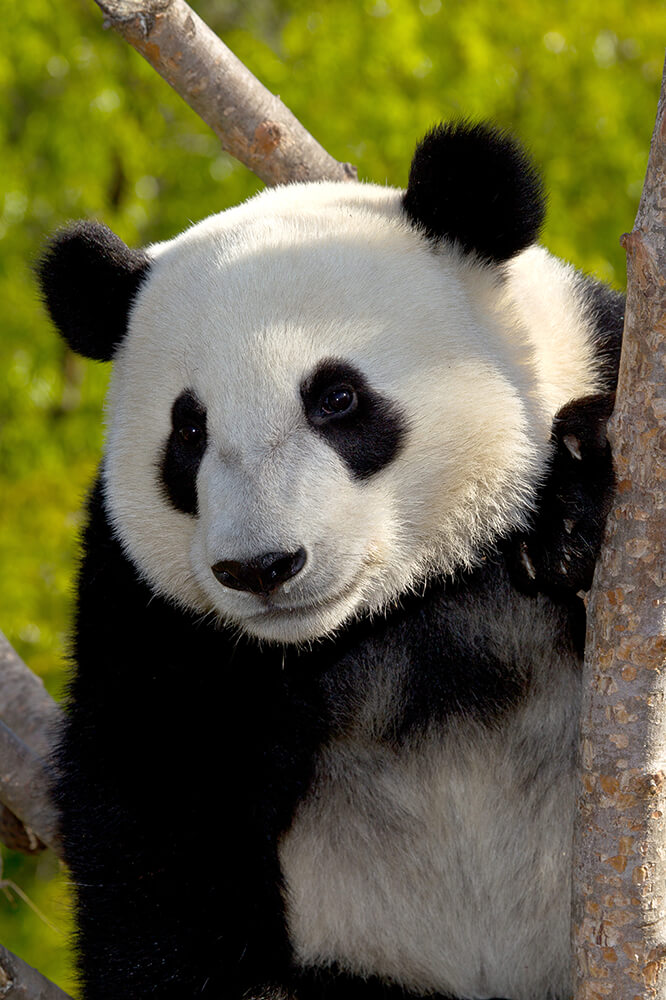
Why are pandas black and white? Scientists aren't exactly sure. One theory is that pandas developed their contrasting black and white colors over time so they would stand out in the forest and be able to find each other to mate. Another idea is that the contrasting color blocking may help camouflage pandas in bamboo or treetops. Anyone who's tried to spot a panda cub up in a tree napping can verify how difficult that can be! Scientists have yet to agree about the real purpose of their coloration. Each panda has markings that are slightly different from any another panda. Rarely, some appear brown and white.
Are giant pandas bears? For years scientists have wondered whether pandas are a type of bear, raccoon, or something all their own. Through studying the genetic code (DNA) in pandas’ cells, scientists have confirmed the panda's relationship with bears. Giant pandas are similar to other bears in their general looks, the way they walk and climb, their skull characteristics, and, importantly, their social system and reproductive biology. It's necessary to know that pandas are bears, because the more we know about pandas, the better we can help them thrive.
Pandas are arguably the most vocal of all the bears. One of the most distinctive of the panda vocalizations is the “bleat.” This sounds similar to the sound a lamb or a goat kid would make, and it’s a friendly sound, a greeting. Pandas can roar, but it doesn't sound the way you think of a brown bear roaring. Other vocalizations include honks, huffs, barks, and growls. Young cubs are known to croak and squeal.
There are other ways pandas communicate, too. Both male and female pandas have a scent gland underneath their short tail that secretes a waxy substance used to leave scent marks. Pandas scent mark trees, rocks, bamboo, and bushes. The scent is pretty strong. Human noses can smell the stinky, waxy scent mark from about a foot away, but pandas are more sensitive to smell, so to them it's even stronger! We’ve discovered that a scent-marked tree or rock can serve as a community bulletin board, notifying pandas in the area that other pandas have been there and how long ago they left their scent mark. Another panda can detect the sex, age, reproductive condition, social status, and even individual identity of the scent maker—as well as how long that scent has been there.
Male pandas often perform “handstands” to leave scent marks. A handstand gets a panda’s rear end higher up the tree, so the scent mark will be higher, too. It seems that pandas are most interested in higher-placed scent marks; the panda with the highest scent mark is obviously the biggest—or at least the tallest—panda.
HABITAT AND DIET
Giant pandas live in the mountains of southwestern China, in damp, misty forests, mostly at elevations between 4,000 and 11,500 feet (1,200 to 3,500 meters). They need old-growth conifer forests with at least two types of bamboo and water access. These old-growth forests provide old, hollow logs and tree stumps large enough for panda dens. Pandas stay in a home range that’s 3 to 7 square miles (8 to 18 square kilometers). In areas where food isn’t as plentiful, the home range might be a bit larger. Like other bears, pandas spend most of the day eating and sleeping.
Bamboo is the most important plant for giant pandas. They spend at least 12 hours each day eating bamboo. They grasp bamboo stalks using their five digits and an enlarged wrist bone called a “pseudo-thumb.” That little pseudo-thumb adeptly holds and manipulates bamboo, almost as well as your thumb does.
Pandas use their teeth to peel off the tough outer layers to reveal the soft inner tissue of the stalk. Strong jawbones and cheek muscles help pandas crush and chew the thick stalks with their flattened back teeth. Bamboo leaves are also on the menu, as pandas strip them off the stalks, wad them up, and eat them. Giant pandas have also been known to eat grasses, bulbs, fruits, some insects, and even rodents and carrion—but about 99% of their diet is bamboo.
At the San Diego Zoo, we offer several hundred pounds of fresh, homegrown bamboo to giant pandas every day. To do this, our horticulture teams grow and harvest nearly a dozen species of bamboo across six acres of dedicated land at the San Diego Zoo and San Diego Zoo Safari Park. In addition, we have even more ornamental species of bamboo planted across the grounds of the Zoo that we also offer seasonally.
Pandas are always associated with bamboo, but they need more than just bamboo to make a home. San Diego Zoo Wildlife Alliance conservation scientists have found that suitable panda habitat requires old-growth conifer forests with at least two types of bamboo and water access. Why is old-growth forest habitat important for pandas? It provides old, hollow logs and tree stumps large enough for dens to raise cubs, and it also provides shelter and nutrients for the bamboo growing there. The average panda’s home range is thought to be about 1.9 square miles (5 square kilometers), with male ranges larger than that of females. In areas where bamboo is not plentiful, the home range may be larger.
FAMILY LIFE
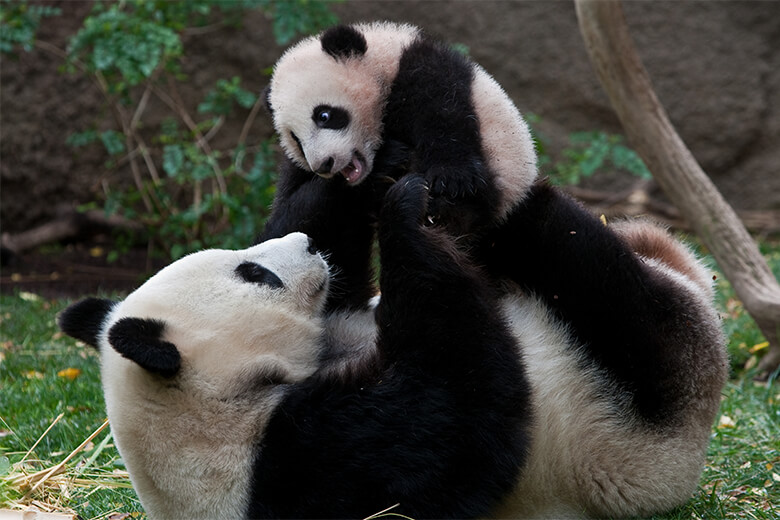
Pandas aren’t party animals by any stretch of the imagination. Like other bears, they spend most of the day eating and sleeping. They're also solitary by nature, and they take their own “space” seriously! Since a panda needs so much bamboo each day to survive, it only makes sense that two’s a crowd when it comes to the bamboo forest. If two pandas happen to cross paths, they’ll growl, swat, and lunge at each other, and maybe even bite each other. There are two exceptions to this: the very brief mating season and mothers with cubs.
Although pandas are naturally solitary as adults, they are exposed to the scents of other neighboring pandas that have crossed over their path days or weeks before. If a female is starting her estrus soon, it makes sense that she would need to advertise her status to any males that might be in the area. She scent marks, and a male that comes across her scent a few days later can recognize the change in her status via that scent mark. Our conservation work in China has confirmed that males are more interested in scent from a female who was known to be in estrus at the time she left the scent.
Once he has identified this change in a female’s status, a male remains closer to this female, assessing her status more frequently and keeping closer tabs on her so he can be present when she is ready for mating. This is important, as there is only one two- to three-day period that the female is receptive to breeding in an entire year. When she is no longer receptive, the male moves on to find another willing female.
Pandas have a slow reproductive rate: mature females usually breed just once every two or three years. In their native habitat, a typical female panda may bear about five litters in her lifetime, and she raises her cubs on her own.
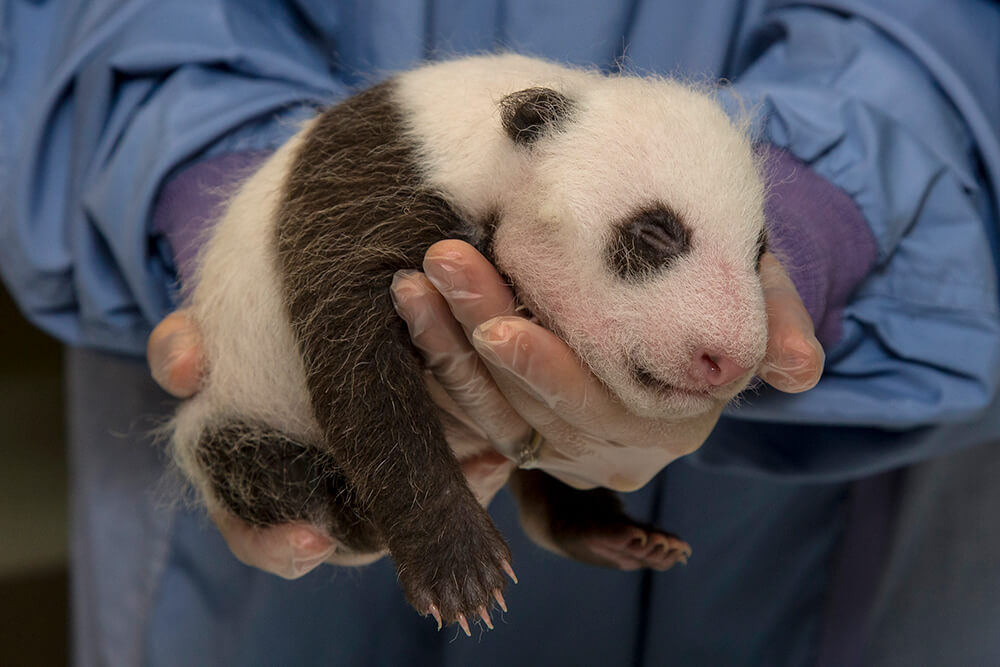
Giant panda cubs are only about the size of a stick of butter at birth. They're born pink, covered in short white hair, and are helpless. The panda mother gives great care to her tiny cub, usually cradling it in one paw and holding it close to her chest. For several days after birth, the mother does not leave the den—not even to eat or drink.
Between one and two weeks old, a panda cub will begin to develop its black markings. Then, the cub opens its eyes and begins to crawl around two months old. Teeth appear by the time it reaches 14 weeks old, and the mother and cub spend much less time using their den. By three to five months old, the cub can walk pretty well. At this time, the cub starts to play with its mother, and at five to six months of age, it starts attempting to eat bamboo. The cub continues to nurse until about 18 months of age. At this time, the mother is ready to send the cub off on its own, so she can prepare for her next cub.
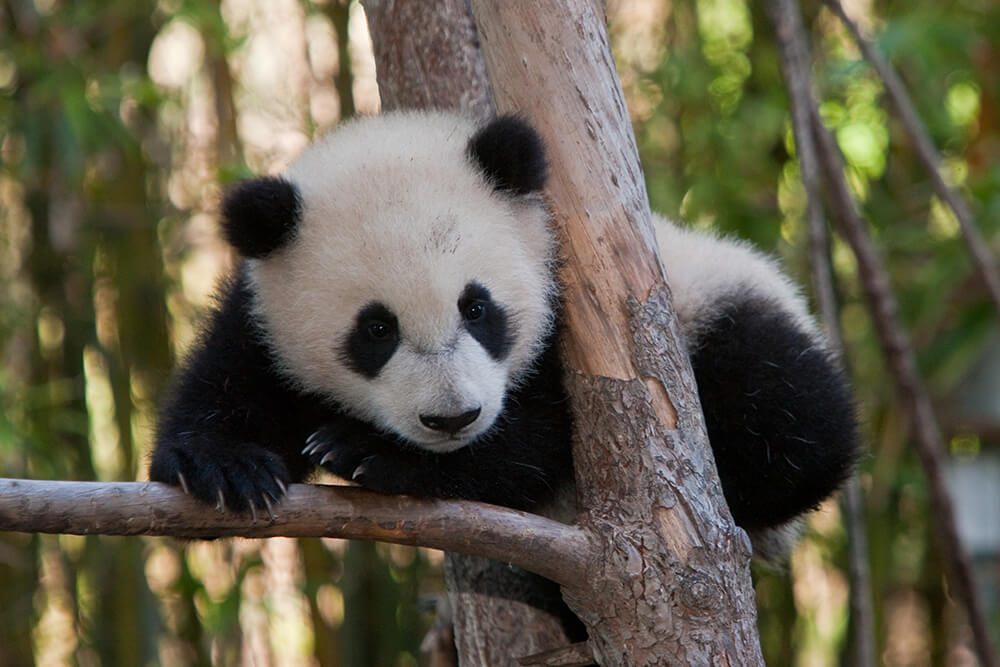
Once a young panda reaches a weight of about 110 pounds (50 kilograms) and is about 2.5 years old, it is probably safe from predators. However, wildlife such as the golden cat, yellow-throated marten, dhole, and weasel prey on panda cubs and juveniles. Long ago, panda cubs were also prey to tigers and leopards, as their relatively slow gait on the ground made them easy pickings. To stay safe, solitary cubs scamper high in trees and remain there until their mother returns, spending hours and hours asleep up in those trees. When they are resting quietly in the branches, they can be hard to spot.
Today, pandas have fewer predators than they did historically. Tigers are generally not found in what remains of panda habitat, and leopards are found in reduced numbers. But the drive to remain safe is still the same, and they can still be seen climbing trees.
AT THE ZOO
The San Diego Zoo has offered expert care for giant pandas since 1996 when our international conservation partnership with China Wildlife Conservation Association began and we welcomed giant pandas Bai Yun and Shi Shi to the Zoo. We renewed our commitment to care for giant pandas with a new cooperative agreement in 2008 and another in 2013. When our cooperative agreement concluded in 2019, all six of the pandas born at the San Diego Zoo returned to China, where they continue to thrive. In 2024 we made a new commitment with China Wildlife Conservation Association and welcomed two pandas once again—Yun Chuan and Xin Bao—who now live in the Zoo's Panda Ridge.
CONSERVATION
Giant pandas face big problems: Today, only about 1,800 giant pandas remain in their native habitats. Until 2016, they were categorized as Endangered on the International Union for Conservation of Nature Red List of Threatened Species. They are currently listed as Vulnerable, thanks to dedicated conservation efforts that have helped to increase their population. However, they still face many serious threats to maintain this progress in the near future.
Habitat destruction: Unfortunately for pandas, China’s forests have changed. As the effects of climate change have increased and land use has shifted, their range shrunk and became highly fragmented. This made it difficult for pandas to move from one area of habitat to another, isolating their already small populations. Fortunately, China responded with strong commitments to protect panda habitat, creating a reserve system of more than 60 giant panda reserves to help protect their native home. Much work remains to maintain their forests, which are vital to their survival.
Low reproductive rate: Pandas are naturally solitary most of the year, and have a very short breeding season. Females give birth to one or two cubs, which are highly dependent on their mother during the first few years of life. Mothers typically only raise one cub, and do so on their own. At the San Diego Zoo, wildlife care specialists help to hand raise any twin cubs. The mother and wildlife care specialists switch twins every few days so each one gets care and milk directly from their mother, plus supplemental formula, which has dramatically increased survival rates for nursery-raised cubs.
Bamboo shortages: When bamboo plants reach maturity, they flower and produce seeds before the mature plant dies. The seeds grow slowly into plants large enough for pandas to eat. Giant pandas can eat 25 different types of bamboo, but they usually eat only the 4 or 5 kinds that grow in their home range. The unusual thing about bamboo is that all of the plants of one type growing in an area bloom and die at the same time. When those plants die, pandas must move to another area. This is why good panda habitat should have several different varieties of bamboo.
Protecting pandas: Panda protection efforts in China began in 1957, and in 1989, the Chinese Ministry of Forestry and the World Wildlife Fund formulated a management plan for continued conservation of giant pandas and their habitat. It called for reducing human activities in panda habitat, managing bamboo forests, extending the panda reserve system, and caring for populations of pandas in zoos and conservation centers.
China's Natural Forest Conservation Program of 1998 provides protection to all remaining forests throughout the panda’s range, which covers about 5.7 million acres (2.3 million hectares).
China has established 67 giant panda reserves that protect panda habitats from further development. Some are off limits to people completely, while others are shared-use areas like our national forests. Natural corridors link some reserves to help connect panda populations.
Today, China is currently gaining forestland. The government has started policies like the “Grain-to-Green” program, which gives grain and cash to farmers who abandon farming on steep slopes and replant these areas for natural forests and grasslands. But we’re still not sure if these newly forested areas are suitable for pandas.
It takes an international effort: Back in the 1990s, biologists didn't know if they could save pandas from extinction. Little was known of their behavior, and pandas did not reproduce often in zoos. Then, San Diego Zoo Wildlife Alliance partnered with Chinese colleagues to create a comprehensive conservation strategy. We developed early-detection pregnancy tests, as well as a milk formula for panda cubs that raised survival rates from five to ninety-five percent. We also began using GPS technology to study pandas and learn how far they travel. In 2010, we reached the milestone number of 300 pandas in zoos worldwide and breeding centers in China, which scientists believe will ensure a self-sustaining population. Fortunately, these efforts have helped boost panda survival rates.
There is still much that we don't know about pandas. Our conservation scientists have learned a lot about panda care, veterinary care, and nutrition; panda reproduction; the importance of ecosystem health; and the significance of chemical communication, or how pandas’ respond to the odors of other pandas. By gathering more than 20 years' worth of data at the San Diego Zoo, where we could observe pandas, we gained a better understanding of what they need to thrive in their natural habitat.
In 2012, we were honored to receive the Association of Zoos and Aquariums' International Conservation Award along with the Smithsonian National Zoological Park, Memphis Zoo, and Zoo Atlanta for our "Scientific Approaches to Conservation of Giant Pandas and Their Habitat." Today, our commitment to giant pandas, and to the collaborative work it will take to ensure they thrive for generations to come, remains steadfast.
How to help: People ask us every day how they can help save pandas. You can make a big impact by making some simple changes in your daily lifestyle, like knowing where the products you purchase come from. By choosing wood products that are certified by the Forest Stewardship Council (FSC), an independent, non-governmental, not-for-profit organization that promotes the responsible management of the world’s forests, you can help protect bamboo forests. FSC-certified forest products are from responsibly harvested and verified sources. Look for the FSC certification on bamboo products, too. You can also help slow the rate of climate change, which scientists predict will have a big impact on giant pandas, by carpooling or turning off the lights when you leave a room, and washing full loads of laundry in cold water whenever possible. When each of us does a little, it adds up to something big—and together, we can change the world.
Join San Diego Zoo Wildlife Alliance today and become an ally for wildlife. Your support makes a world of difference.