
Elephant

- Class: Mammalia (Mammals)
- Order: Proboscidea
- Family: Elephantidae
- Genera: Loxodonta (African) and Elephas (Asian)
- Species: africana, cyclotis, and maximus
- Subspecies: E. maximus indicus (Indian), E. maximus maximus (Ceylon), E. maximus sumatranus (Sumatran)
ABOUT
Have you “herd”? They’re enormous and intelligent, strong and sociable. People have been impressed by elephants for centuries, simply because they are so big—a male African elephant can weigh up to 7.5 tons (6.8 metric tons)! They also amaze us with their long and flexible trunks, large and flapping ears, and loose, wrinkly skin. There are many stories about elephants—you’ve probably heard of Horton, Babar, and Dumbo.
If all elephants seem the same to you, take a closer look. There are three types of elephants that are usually recognized: African savanna elephants, African forest elephants, and Asian elephants. There is some ongoing debate about how many subspecies may exist, or whether some of these might, in fact, be species in their own right. Here are a few ways to tell them apart:
- African elephants (both species) have large ears shaped like the continent of Africa, both males and females have visible tusks, their skin is very wrinkly, their back is swayed, and the end of their trunk works as if they have two fingers there to help them pick things up. African elephants are the largest mammals on land.
- Asian elephants have smaller ears, usually only the males have visible tusks, females have small tusks called “tushes,” they only have one “finger” at the end of their trunk, and their back is dome-shaped.
An elephant’s ears work like a radiator. As elephants flap their ears on a hot day, their blood flows through many blood vessels spread throughout their large ears and cools down. If they have just splashed around in a river, all the better! This ear flapping behavior cools their large bodies on warm days.
The term “pachyderm” is from the Greek word pachydermos, which means “thick skinned.” This term often refers to elephants, rhinos, and hippopotamuses.
An elephant’s skin can be up to 1 inch (2.54 centimeters) thick on some parts of its body. It’s also wrinkly, which keeps an elephant cool by trapping moisture that takes longer to evaporate. And even though it’s thick, an elephant’s skin is also very sensitive to touch and sunburn. Elephants often spray themselves with water or roll in the mud or dust for protection from the sun and biting insects.
Tusks are an elephant’s incisor teeth—in fact, they’re the only incisors an elephant has. Elephants use them for defense, digging for water and food, and lifting things. Tusks present at birth are called “milk teeth,” and fall out after a year when they are about 2 inches (5 centimeters) long. Permanent tusks extend beyond an elephant’s lips at about two to three years old and grow throughout an elephant’s life. Tusks are composed of ivory (dentine) beneath the outer layer of enamel, but the peculiar diamond pattern of an elephant’s tusk gives it a distinctive luster that ivory tusks of other mammals such as hippos, warthogs, walruses, and sperm whales don’t have, and African elephants are unfortunately sometimes hunted by poachers just for their ivory tusks.
Elephants also have four molars, one on the top and one on the bottom on both sides of their mouth. One molar can weigh about 5 pounds (2.3 kilograms) and is the size of a brick! An elephant can go through up to six sets of molars in their lifetime.
New teeth do not erupt vertically, as in most mammals, but grow in from behind, pushing the old worn-out teeth forward and out, moving along the jaw from back to front. In very old elephants, the last (sixth) set of molars can become sensitive and worn down. These elephants may prefer to eat softer food. Marshes are the perfect place to find soft plant food, so old elephants often spend the rest of their lives there. This practice led some people to think that elephants chose special burial grounds for themselves.
An elephant’s trunk serves as both an upper lip and a nose. There are eight major muscles on each side of the trunk and 150,000 muscle fascicles (portions of muscles) throughout the entire trunk. There are no bones or cartilage in this unique appendage. An elephant’s trunk is so strong it can pick up large tree trunks and so agile that it can pick up a single piece of straw. Elephants also use their trunk like we use our hands: to grab, hold, pick up, reach, touch, pull, push, and throw.
The trunk is still a nose, too, and has two nostrils at the end that suck air up the long nasal passages and into the lungs. Elephants also use their trunks to drink, but the water doesn’t go all the way up the nose like a straw; instead, the elephant sucks water only part way up the trunk, curls it toward its mouth, tilts its head up, and lets the water from the trunk pour in.
Elephants make many different sounds; people cannot hear some of these sounds, as their frequency is too low for our ears. Elephants use these sounds to communicate with each other over long distances. Have you ever had your stomach growl at an unfortunate moment? Well, that rumble sound is a welcome sound in elephant society; rumbling and growling noises seems to signal to others that everything is “okay.” In addition to rumbling and growling, elephants also communicate by trumpeting, bellowing, squealing, roaring, and barking.
The largest elephant on record was an adult male African savanna elephant. He weighed about 24,000 pounds (10,886 kilograms) and was 13 feet (3.96 meters) tall at the shoulder! Most elephants don’t get that large, but African elephants do grow larger than Asian elephants.
HABITAT AND DIET
Home is where the herd is. Asian elephants (Elephas maximus) live in scrub forests and rainforests in India, Nepal, and parts of Southeast Asia. They often choose to live near rivers during dry months.
African savanna elephants (Loxodonta africana) live in eastern, central, and southern Africa, inhabiting lowland and montane forests, flood plains, and all types of woodland and savanna. African forest elephants (Loxodonta cyclotis) inhabit the Congo basin and western Africa in moist, semi-deciduous rainforests.
Elephants eat all types of vegetation, from grass and fruit to leaves, roots and bark—about 165 to 330 pounds (75 to 150 kilograms) each day, which is about 4 to 6 percent of their body weight. They spend an average of 16 hours per day eating! African elephants are grazer-browsers and eat grasses, including sedges, flowering plants, leaves, shrubs, and small- to medium-size trees. African forest elephants are browser-frugivores and eat leaves, fruits, seeds, branches, and bark. Asian elephants are both browsers (feeding on shrubs and trees during the dry season and after heavy rains) and grazers (feeding on grass during the first part of the wet season). They can consume many types of plants, including twigs and bark. The choice of plants varies with seasons.
Elephants at the San Diego Zoo and San Diego Zoo Safari Park eat over fifty different types of plants including browse and grasses. They drink about 20 to 50 gallons (75 to 190 liters) of water each day.
FAMILY LIFE
Most elephants live in close social groups called herds, usually made up of related females and their offspring. The leader of the herd is known as the matriarch; she is usually the oldest and most experienced female in the group. It’s her responsibility to remember where and how to find food and water, how to avoid predators, and to choose the best places for shelter. She also keeps the younger elephants in line and teaches them how to behave in elephant society. In some cases, the herd may include one of the matriarch’s sisters and her offspring. When groups get too big, “bond groups” split off but maintain a loose association.
Males don't usually live within the family herd after they reach adolescence. Once male elephants are old enough to find their own food and protect themselves, they leave the family herd and live on their own or form small bachelor herds with other males. Males are quite social, but once they are mature adults they set off on their own to visit herds of females, and that is only for short periods of time to breed. Bulls do not take part in caring for the young.
Good manners are important in elephant society. Trunks are used in greeting: a lower-ranking individual will insert its trunk tip into the other’s mouth. A trunk may be held out to an approaching elephant as a greeting and is also used in caressing, wrestling, and checking reproductive status.
Elephant calves could fall prey to hyenas, lions, leopards, or crocodiles, but as long as they stay near Mom or their herd, they have little to worry about. If an elephant senses danger, it trumpets a loud alarm call to alert the others. The herd then forms a protective ring called an “alert circle,” with youngsters in the middle and the adults facing out to confront a potential predator. A healthy adult elephant’s only real threat are people.
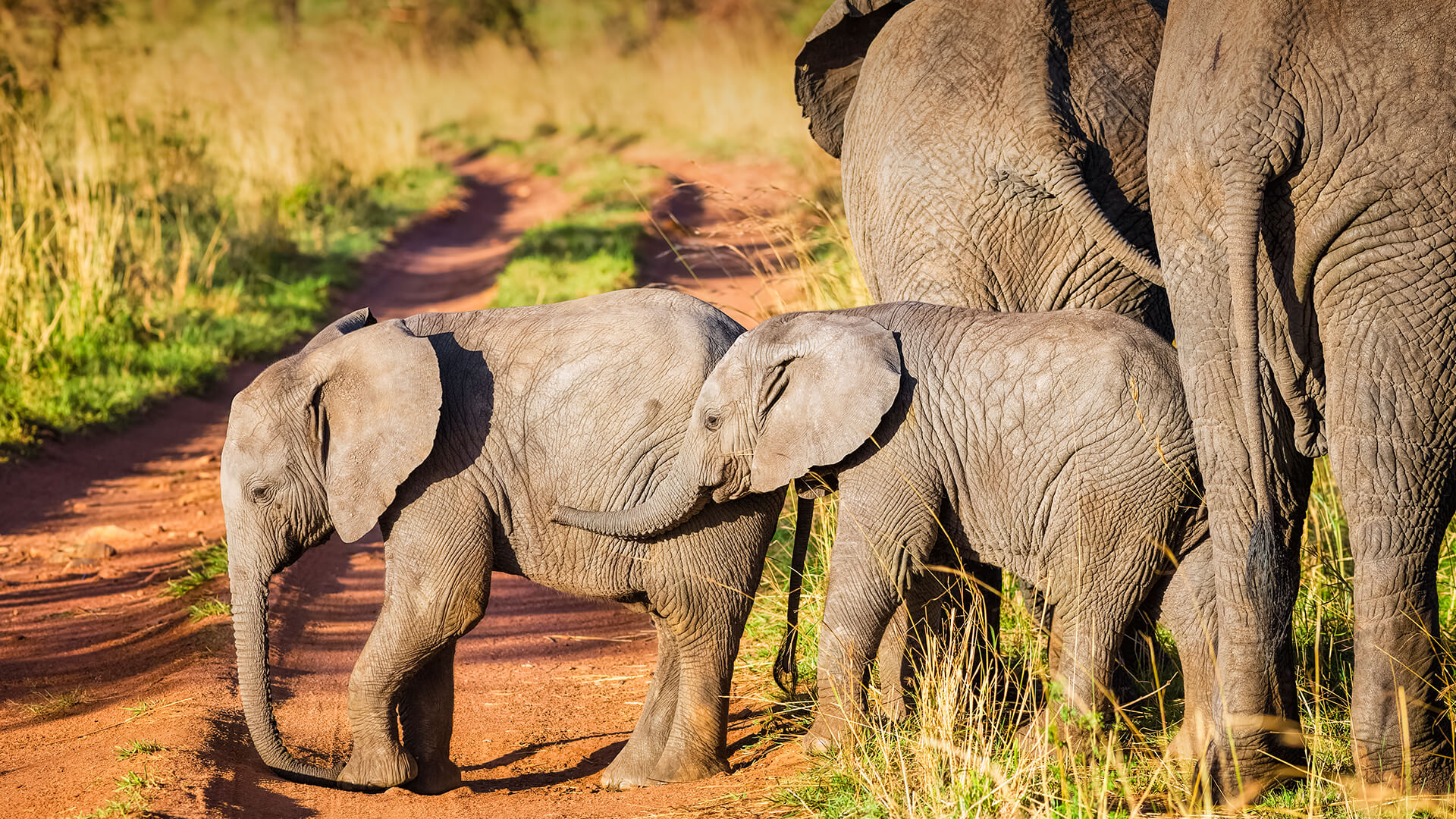
At birth, a baby elephant, called a calf, may stand three feet (one meter) tall. A calf is usually quite hairy, with a long tail and a very short trunk, and is very dependent upon its mother and other members of the herd. The little one uses its mouth to drink its mother’s milk, so it doesn’t need a long trunk yet to feed. Calves stick close to Mom and nurse frequently; they gain, on average, 2 to 3 pounds (1 to 1.3 kilograms) a day in their first year! Herd mates tend to naturally look out for calves.
Calves spend their days practicing making all four legs go in the same direction at the same time, perfecting their ear flaring, and mastering trunk control. Calves are clumsy at first with their trunk, but they learn to use it as they grow older. By the time they are two to three years old, they no longer need to nurse. Despite lots of playtime and protection, calves also have to navigate herd social dynamics and establish their rank within the herd. By choosing who to follow and spend time with, and how to communicate, they begin to make their mark.
AT THE ZOO
The San Diego Zoo has had the honor of caring for elephants for more than a century. We first began caring for Asian elephants in 1923 when two females, Empress and Queenie, arrived via train from San Francisco. The Zoo’s founder, Harry Wegeforth, M.D., was there to greet them, and off they walked from the train station to the Zoo, gathering many astonished looks along the way! Today we care for African savanna elephants at both the San Diego Zoo and San Diego Zoo Safari Park.
The San Diego Zoo’s Elephant Odyssey features our world-class Elephant Care Center, with state-of-the-art assistive technology to offer highly specialized care for elephants with unique physical needs. The San Diego Zoo Safari Park’s all-new Denny Sanford Elephant Valley, offers the opportunity to experience being on common ground with elephants by walking alongside them in a fully immersive experience.
To best care for elephants at both the San Diego Zoo and San Diego Zoo Safari Park, elephant care specialists utilize the science of operant conditioning and positive reinforcement training to teach them how to participate in their ongoing healthcare and wellness routines. Whether daintily presenting a foot for nail care, patiently standing parallel for a bath, or holding up their trunk for a saline flush, elephants participate in their own health-care routines.
CONSERVATION
Today's native elephant populations face threats from poaching, habitat loss and fragmentation, and coexistence with people. Poaching is a cause of population decline in all elephants. Despite the knowledge that their tusks are made of ordinary dentine, like our teeth, consumers continue to illegally purchase elephant tusks, so poachers persist in illegally hunting elephants. Elephants are now protected, but poachers still hunt them, and they face other life-threatening challenges, too. As populations of people expand, elephant habitats shrink. Growing farms and developing infrastructure to support people often disturb or displace elephants. This can not only lead to a loss of suitable habitat for elephants, but can also create conflict between people and elephants when they compete for resources.
Asian and African savanna elephants are listed as Endangered on the International Union for Conservation of Nature Red List of Threatened Species. African forest elephants are Critically Endangered.
We support and advance elephant conservation through a variety of methods, including the study of elephant behavior and reproductive biology. In one multidisciplinary approach, our scientists recorded elephant auditory communication and behavior for a clearer understanding of the social dynamics of a herd and the relationship between mother and calf. In another, we documented and studied calf weights as a measure of health. The knowledge gained from our studies not only helps us care for elephants in San Diego—it’s also shared with our international conservation partners to help elephants around the world.
To understand how elephant activity levels at the San Diego Zoo San Diego Zoo Safari Park compare to elephant activity levels in native habitats, our conservation scientists studied elephants' movement patterns with the help of movement-based GPS technology. Our team found that eight elephants at the Safari Park walked an average of 3 to 7 miles (5 to 11 kilometers) per day, and walked the most during the middle of the day. These distances are comparable with what has been observed in elephants in Africa. Also, the relationship of the walking rate and time of day mirrors activity patterns observed in some populations of elephants in Africa.
We work with partners across our Savanna Conservation Hub in Africa to advance elephant conservation through land preservation, scientific study, rehabilitation, and by promoting peaceful coexistence between people and elephants.
In Kenya, we work with Kenya Wildlife Service, Save the Elephants, and the Northern Rangelands Trust to help local ecologists and rangers conserve populations and improve coexistence between people and elephants in the area. We also partner with the Reteti Elephant Sanctuary, where local community members care for, rehabilitate, raise, and eventually reintroduce orphaned African elephants.
The small country of Botswana hosts the largest elephant population remaining on the African continent. San Diego Zoo Wildlife Alliance has partnered with Elephants Without Borders (EWB) to delve further into questions about elephants, their behavior, and the best ways to help conserve them. To do this, we study blood samples in ongoing genetic studies, and fecal samples to learn about diet and stress in elephant populations. These insights help us understand health conditions and possible motives for elephant travels.
Elephants Without Borders has been observing elephant movement throughout northern Botswana since 2000, having tracked over 90 individual elephants; this is one of the longest and largest elephant movement studies in Africa. Every individual elephant has a unique character and intriguing story to his or her own seasonal march, preferred routes, and favored places. Each elephant offers unique insight and helps us learn more about elephant ecology. Unpredictable individual ranging behavior coupled with a dynamic, ever-changing environment in Botswana underscore the need for long-term elephant studies. Scientists observe elephants from a fixed-wing airplane, which allows a visual assessment and helps us learn more about herd structure and habitat use.
In collaboration with San Diego Zoo Wildlife Alliance, Elephants Without Borders has established a conservation farming project in the Chobe Enclave in Botswana. This project involves developing farming plots with various methods of protection for crops, livestock, and elephants. Along with aerial survey wildlife counts and elephant movement data, these projects are essential for developing community-based conservation programs to promote peaceful coexistence between people and elephants and make better-informed conservation decisions for all.
In addition, San Diego Zoo Wildlife Alliance has developed groundbreaking anesthesia techniques that can be offered, when needed, to care for elephants at zoos and across native habitats by our partners and other veterinary experts in the field. San Diego Zoo Wildlife Alliance is also an active member of the International Elephant Foundation. All of these efforts allow us to continue to offer world-class care for elephants and to conserve elephants across Africa and Asia.
By joining San Diego Zoo Wildlife Alliance as an ally for wildlife, you help save wildlife worldwide.